


Skip to content
Contact Us
Background image
LEGAL DATA CONTINUITY™

Keep legally significant data protected through change

 Legal obligations can outlive the systems, tenants, or accounts holding the data. They should not require obsolete infrastructure to remain in place. 

What is Legal Data Continuity?

Legal Data Continuity separates information with continuing legal or governance requirements from the systems, accounts, and data populations around it. That separation depends on four things.

Legal status that survives the transition

Legal, regulatory, contractual, client, and governance requirements remain associated with the information after the system, account, or platform changes.

Context that survives the source

Information remains understandable after the original environment is gone, with the identity, source, metadata, and relationships needed to interpret it.

Controlled access for future use

Authorized teams can search and use required information for a future matter, investigation, or request without restoring the legacy environment.

Disposition when the requirement ends

Approved disposition removes the information when its requirements end while retaining the audit history needed to explain the decision.


What Legal Data Lock-In™ costs

Legal Data Lock-In is why systems that should have been retired years ago are still running: a small part of what they hold still has to be kept. Its costs go beyond a single budget line item, and each manual step risks something being overlooked.

Systems and data that stay too long

Costs compound because as long as required data lives in a legacy system, every preservation, collection, search, or request has to account for two places instead of one.

INFRASTRUCTURE Legacy systems outlast their operational value
TRANSITION DELAY Retirements and integrations stay incomplete
DATA VOLUME Old data gets carried into new production systems
Work and exposure that compound

The problem is becoming more common. Each change creates another situation where legally significant data must be identified and preserved through change.

MANUAL WORK Teams keep reconciling identities, holds, and exceptions
PRIVACY AND SECURITY More data stays available to more users
FUTURE DISCOVERY Context decays, so later access costs more

Give legally significant data the right future

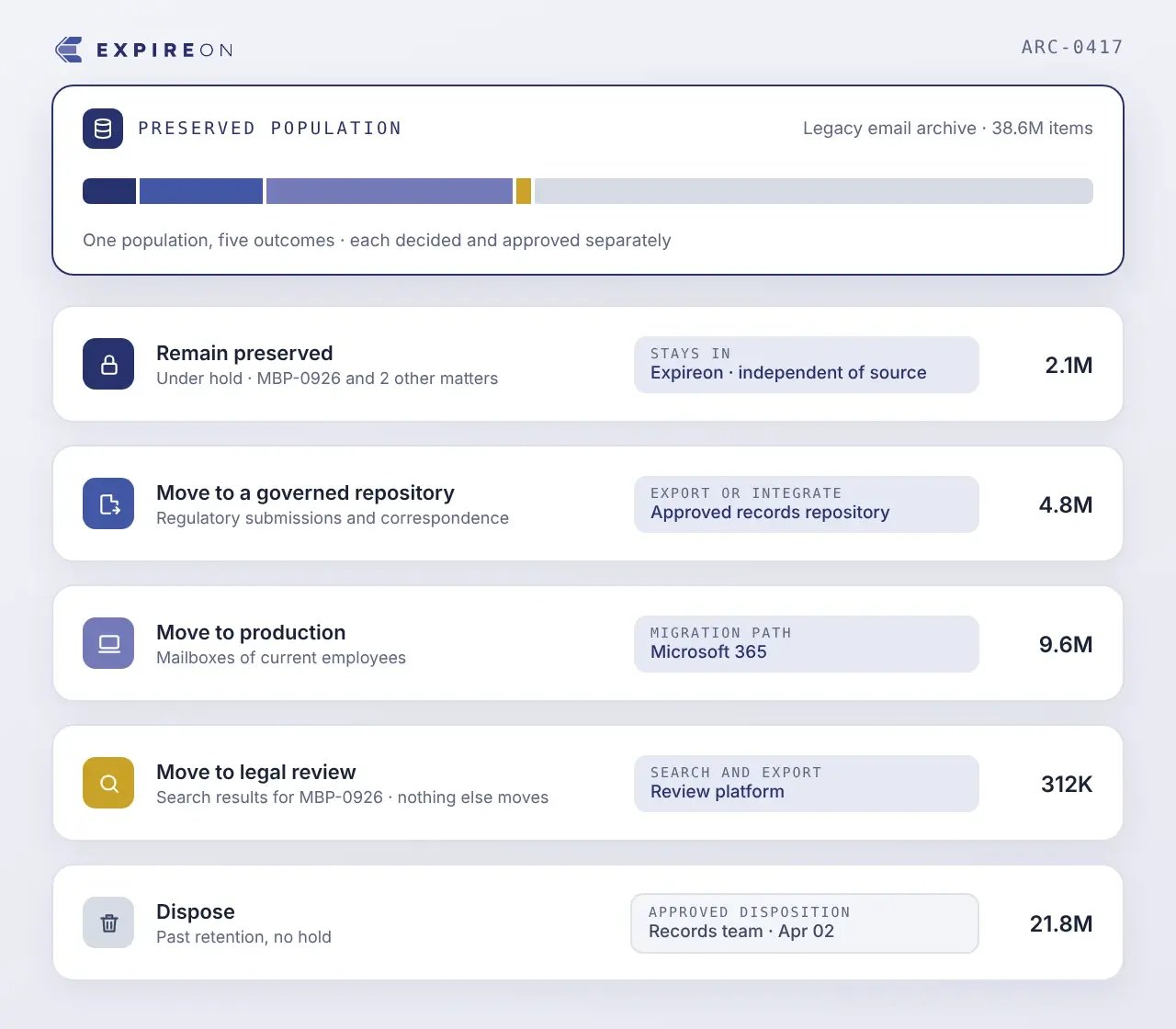
Preservation is not the final state for every population. Different information can require different future outcomes.

  • Remain preserved | Keep the information governed and accessible independently of the system it came from.
  • Move to a governed repository | Export or integrate the selected population to the approved destination.
  • Move to production | Use the appropriate migration path to the target production system.
  • Move to legal review | Search and export the relevant population without moving everything.
  • Dispose | Apply approved expiration or disposition.
give-legally-significant-data-the-right-future

Shared value across legal, information governance, and IT

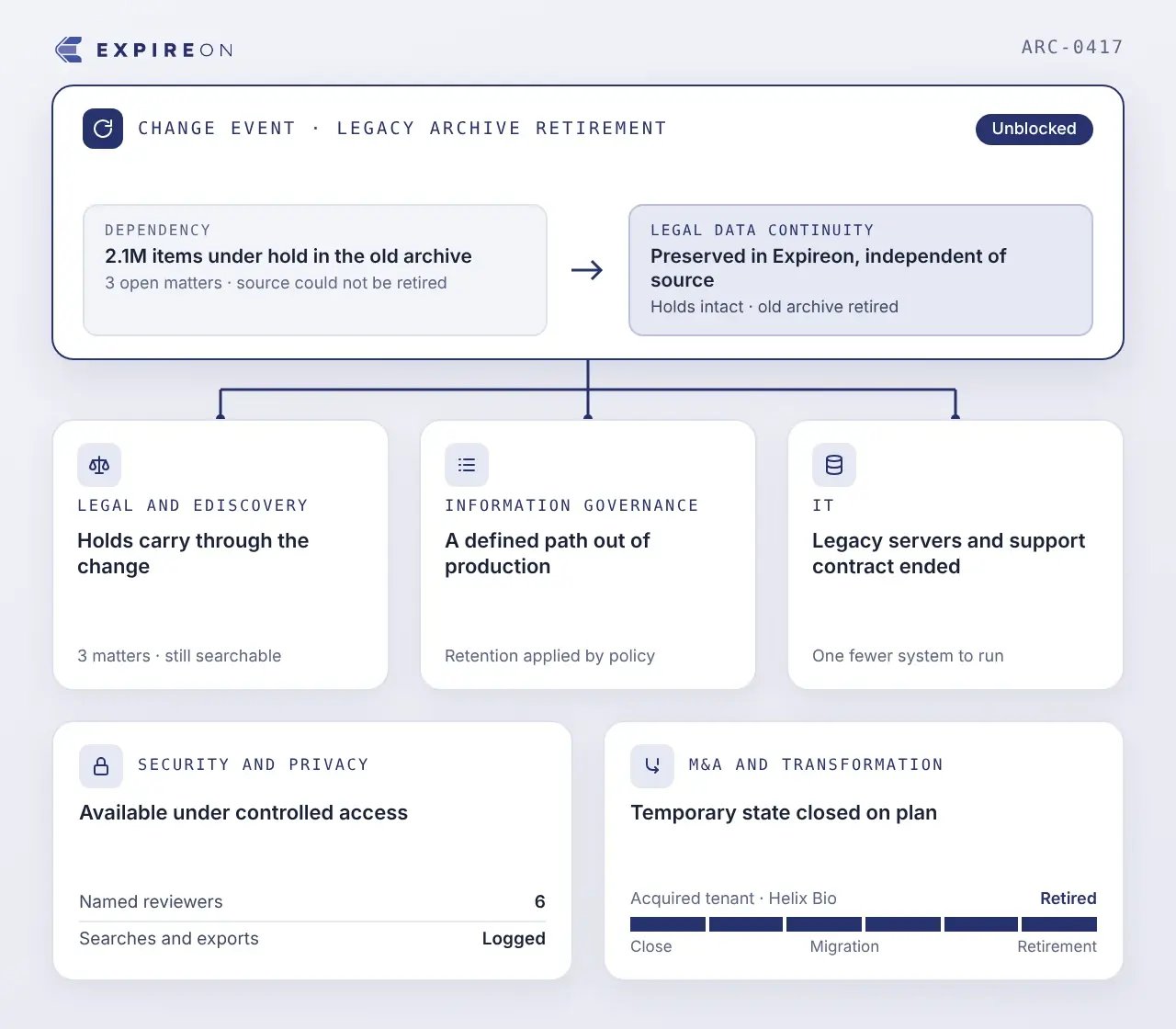
Legal Data Continuity provides shared value by removing the dependencies that block projects and change events while allowing continued compliance with legal obligations.

  • Legal and eDiscovery | Reduce the risk that required information becomes inaccessible when environments change.
  • Information governance | Create a defined path for information that no longer belongs in ordinary production use.
  • IT | Reduce the infrastructure and operational dependencies created by required historical data.
  • Security and privacy | Limit exposure while keeping required information available under controlled access.
  • M&A and transformation teams | Keep data obligations from extending temporary technology states longer than necessary.
shared-value-across-legal-ig-and-it

How Legal Data Continuity works

The same five stages apply whether the change is a retiring archive, a closing account, or a completed transaction. Preservation must come first because it is the one step that cannot be taken later.

01
Preserve

Protect information that remains subject to legal, regulatory, client, contractual, or governance requirements before systems, accounts, ownership, or access change.

02
Understand

Maintain useful identity, source, metadata, and relationship information so preserved populations remain understandable after the original environment changes.

03
Triage

Determine which information should remain preserved, move to another destination, receive additional review, or become eligible for disposition.

04
Transition

Move validated information to a DMS, production platform, downstream legal workflow, buyer or seller environment, or another approved destination when appropriate.

05
Govern

Control access, legal hold, retention, expiration, export, and disposition until the requirement to keep the information ends.

Legal Data Continuity solutions

Legal Data Continuity looks different depending on what is changing. Each of these events begins with a different trigger and ends the same: required information governed independently of whatever is being retired, closed, or moved.

A system is being retired Archive retirement

Preserve required information so legacy archives and retired applications can be decommissioned without losing future legal access.
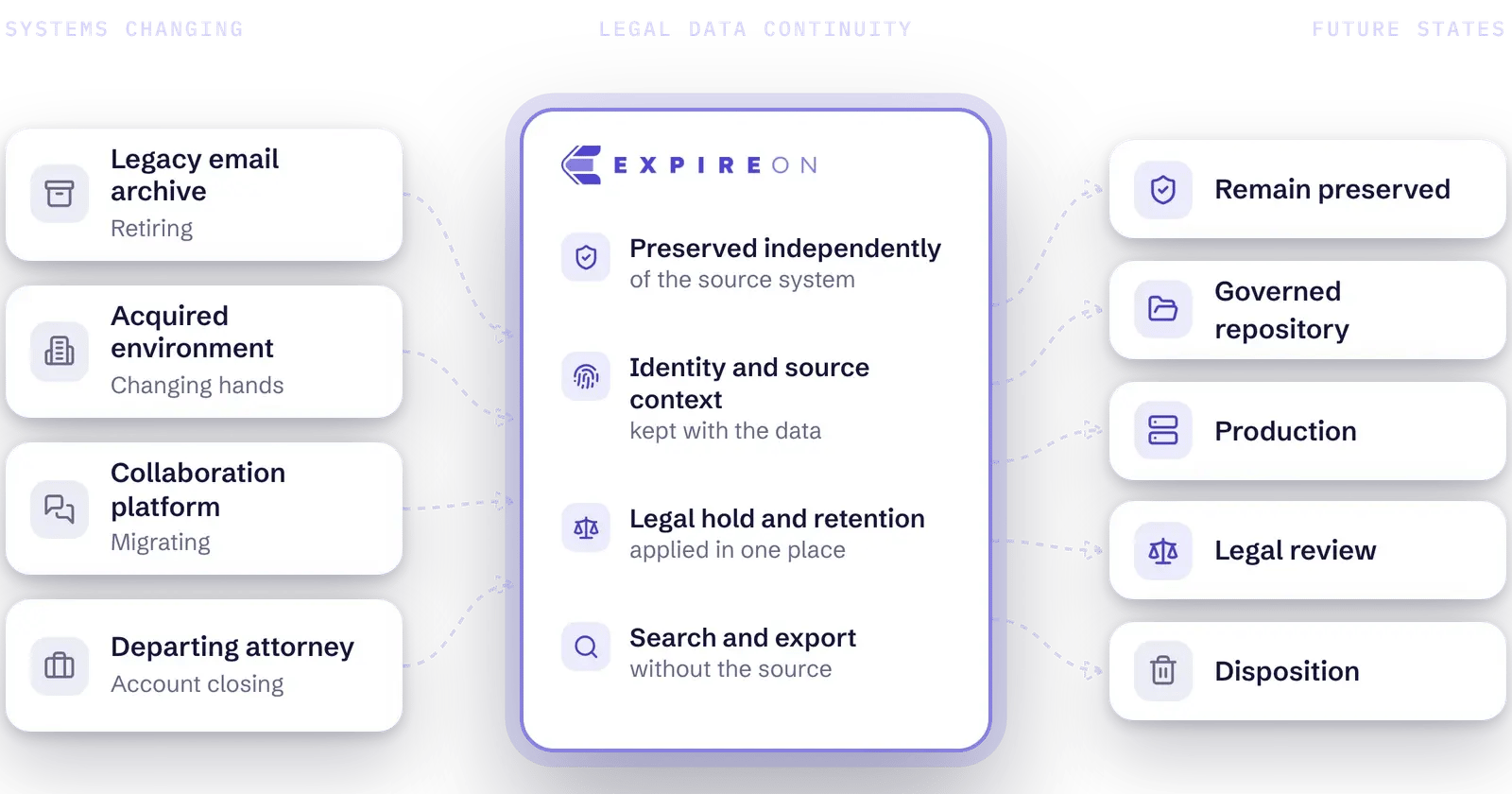
An organization is changing M&A and divestiture data preservation

Protect information with continuing obligations while acquired environments are integrated or divested environments are separated.

A platform is changing Collaboration platform migration

Preserve collaboration history that must survive the migration without adding preservation-only data to the new production platform.

An attorney is leaving Attorney transition & client data governance

Preserve departing-attorney data while the firm identifies and transfers client or matter information that should remain governed.

Expireon is the Legal Data Continuity platform

Expireon provides the governed environment for legally significant historical and transition data when that information needs to remain independent of its original system, account, or broader production population.

Depending on the use case and source, Expireon can support ingestion, preservation, historical identity, search, AI-assisted classification, controlled access, export, retention, expiration, and disposition.

eo-product-01-hero-1

Run migration and Legal Data Continuity as one program

Most transitions involve both problems at once. Sorting what belongs in the next production environment from what carries continuing obligations is usually the hardest part of the project, and the part most programs discover late.

What migration handles
  • Moves active or required business data into its next production environment.
  • Data that still supports business operations
  • The right migration path for each target system
  • No preservation-only data added to the new platform
What Legal Data Continuity handles
  • Preserves and governs information whose continuing requirements do not depend on immediate production use.
  • Data with continuing legal and governance obligations
  • Expireon as the destination for legally significant data
  • Approved disposition when requirements end

Legal Data Continuity FAQs

What is Legal Data Continuity?

Legal Data Continuity ensures that legal, regulatory, contractual, client, and governance obligations survive changes to systems, platforms, organizations, and personnel. It allows the original environment to be retired while required information remains preserved, understandable, accessible, and governed.

What is Legal Data Lock-In?

Legal Data Lock-In occurs when information subject to continuing obligations remains dependent on a system, account, platform, or data population the organization needs to change or retire. Even if the data can technically be exported, it remains locked in if its obligations, context, accessibility, or disposition cannot be maintained independently.

Why isn’t migrating or exporting the data enough?

Migration moves information, but it does not necessarily establish what should be retained, where it belongs, or when it can be disposed of. Without that decision-making and governance, organizations often carry entire historical populations forward and recreate the same dependency in a new environment.

How is Legal Data Continuity different from backup or archiving?

Backup is designed to restore information after loss, while an archive primarily provides a place to store it. Legal Data Continuity preserves information for a defined purpose, maintains the context and obligations attached to it, supports future legal use, and enables defensible disposition when that purpose ends.

When does an organization need Legal Data Continuity?

It is most valuable when retiring a legacy system, completing an acquisition or divestiture, consolidating tenants, replacing a collaboration platform, or closing a departing employee’s or attorney’s account. In each case, some information may need to outlive the environment or person that created it.

How does Legal Data Continuity support legal holds?

When a hold may outlast its source environment, the relevant information can be preserved independently so the obligation remains attached to the data rather than the original system. This helps maintain hold continuity through migrations, platform retirements, tenant consolidations, and account closures.

What happens to information preserved through Legal Data Continuity?

Each population is evaluated and directed toward an appropriate future state. It may remain preserved, move to a governed repository, return to production, move into legal review, transfer to another organization, or proceed to disposition when no continuing obligation remains.

How does Cloudficient deliver Legal Data Continuity?

Cloudficient operationalizes Legal Data Continuity through Expireon, a governed environment for information that must survive a transition without keeping the original production system running. Expireon preserves legally significant data with its identity, source, metadata, and relationships intact; keeps it searchable and exportable; maintains its obligations; and supports auditable disposition when those obligations end.

Keep legally significant data protected

See how adopting Legal Data Continuity can help your organization preserve required information through technology and organizational change, keep it accessible while obligations continue, and move or dispose of it when requirements change.