A retention period is active
Data remains preserved until its applicable retention period ends.




Apply different retention treatment to different populations, suspend expiration while a legal hold or another requirement applies, and dispose of eligible data through an approved process, with audit history you can explain years later.
Most organizations have an approved records schedule. The challenge is applying it to legacy data when the context needed to distinguish what must be retained from what can proceed to disposition is missing.
Without the context, the result is a single long retention period applied to everything, or no expiration at all. It is a consequence of Legal Data Lock-In™: data the organization is entitled to delete and cannot safely delete.
Expireon™ preserves the context needed to apply the appropriate retention category, duration, and trigger to each population. Information follows the organization’s approved schedule instead of a blanket default.
Expireon applies the organization’s retention framework consistently across information from different source systems. When a requirement ends, the information can proceed through governed expiration and disposition.
CaseFusion® manages the legal hold; Expireon™ governs the information preserved under it. While a hold remains active, scheduled expiration is suspended. Releasing the hold does not authorize disposition if another retention or governance requirement still applies.
Data remains preserved until its applicable retention period ends.
Scheduled expiration stays suspended while the legal hold remains active.
Scheduled expiration remains suspended until every applicable hold has been released.
Releasing one hold removes that restriction. Any other hold, retention period, or governance requirement must also have ended before disposition.
Eligible data enters the organization’s approved disposition process when no applicable requirement remains.
Retention and disposition decisions get questioned long after the people who made them have moved on, and often after the data itself is gone. Audit history has to survive both.
Gives the preserved historical population an end date rather than an indefinite new home.
Applies the acquiring organization's own retention framework to inherited populations.
Keeps preservation-only populations governed and reducing outside the new production environment.
Retains departing-attorney and departed-user data for the period the firm's obligations require, and no longer.
Retention and disposition decisions may need to be explained after the people who made them have moved on and the data has been disposed of. The audit history must remain available to show what happened and why.
The source population, preserved metadata, ingestion activity, and recorded exceptions.
The retention category applied, any AI-assisted classification used to inform it, and later changes to either.
The policy, start date, duration, expected expiration, and any approved change to the schedule.
Preservation dates, the associated matter, and the hold status governing the data. CaseFusion remains the system of record for legal hold.
User, policy, configuration, access, and override changes that affect governance.
The population disposed of, the date, the outcome, and any exceptions or failures.
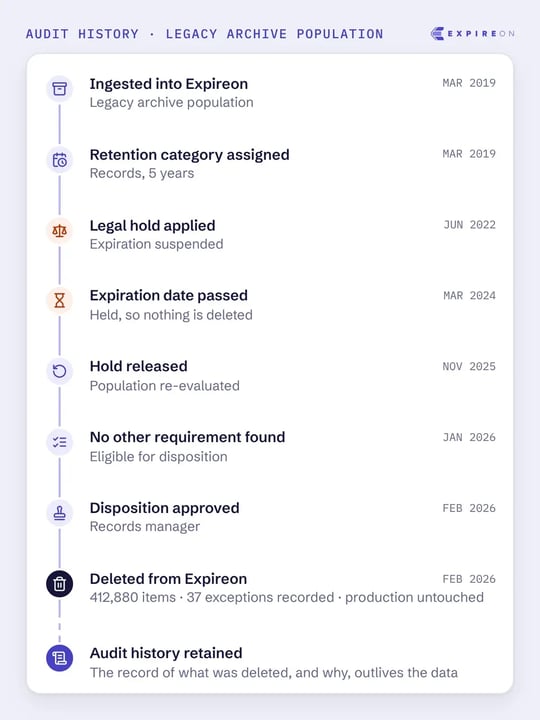
Disposition is a governed outcome rather than a storage event. Every step below produces something the organization can point to later.
Identify data whose approved retention period has ended or whose expected expiration date has passed.
Assigning retention treatment to a large historical population requires knowing what is in it. AI Studio classifies email using models trained on the organization's own examples, as one input alongside metadata, source, and review.
Classification categories are separate from retention categories and do not replace a records schedule. Approved governance policy determines the categories, durations, triggers, and whether anything is disposed of, with human review for exceptions.
Use classification to focus review effort without giving the model authority over the legal decision.
What is data disposition?
What happens to a legal hold when the retention period ends?
Does releasing a legal hold mean the data can be deleted?
Can AI decide what data to delete?
What audit history should a disposition leave behind?

We will walk through how retention categories would map to your governance framework, how holds would interact with your schedules, and what audit history would show about a disposition years later.