Interviews reveal business context, informal collaboration, and people or systems that records may not show.

Identify the right custodians and data sources early
A custodian list is only a starting point
Most matters begin with a list of likely custodians based on current records and team knowledge. That list is necessary, but it rarely captures historical roles, shared repositories, or activity outside named accounts.
Current records may not show a person’s role during the relevant period, former employees who held responsibility, or moves between departments.
Shared repositories, non-custodial sources, and content associated with people outside the initial list may also be in scope.
When information is missing, teams compensate with broader holds, more repositories, and longer date ranges.
Broader scope may be appropriate, but it sends more ESI into processing and review without necessarily resolving the uncertainty that caused it.
Identification is where defensibility starts
Identification determines who receives a hold, which repositories are investigated, what is preserved and collected, how much ESI enters review, and whether the legal team can explain any of it afterward.
A missed custodian, repository, or linked document creates discovery risk, and the gap may only surface after preservation and collection have already moved on.
An unnecessarily broad scope creates cost and operational burden. Once ESI enters processing and review, the consequences of the original scoping decision are difficult and expensive to reverse.
Context-Aware eDiscovery™ treats identification as a continuing, information-driven process. The scope set at the beginning is inherited by everything that follows, and it should be revisited as the matter teaches the legal team more.
Combine system information…
No single source answers the identification question on its own. System information shows who people were, what they did, and how documents connect.
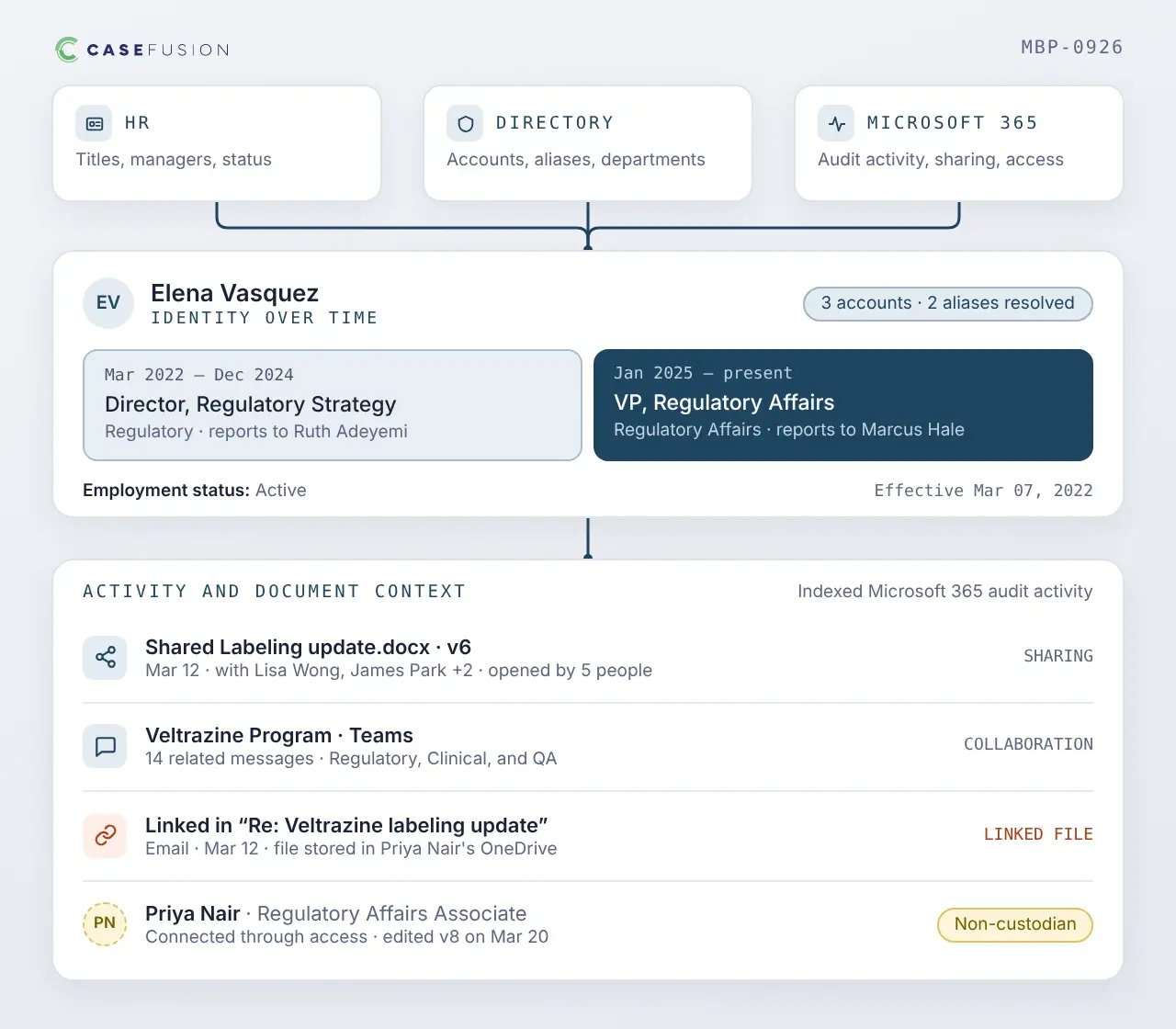
- Identity over time | Historical titles, departments, managers, reporting relationships, and employment status, with the dates each was in effect.
- Activity and document context | Indexed Microsoft 365 audit activity, sharing and collaboration patterns, files referenced in communications, and the people connected through access.
…with human knowledge
System-derived information supports legal judgment, which stays with the legal team. CaseFusion® brings every input into one place so they can be weighed against each other.
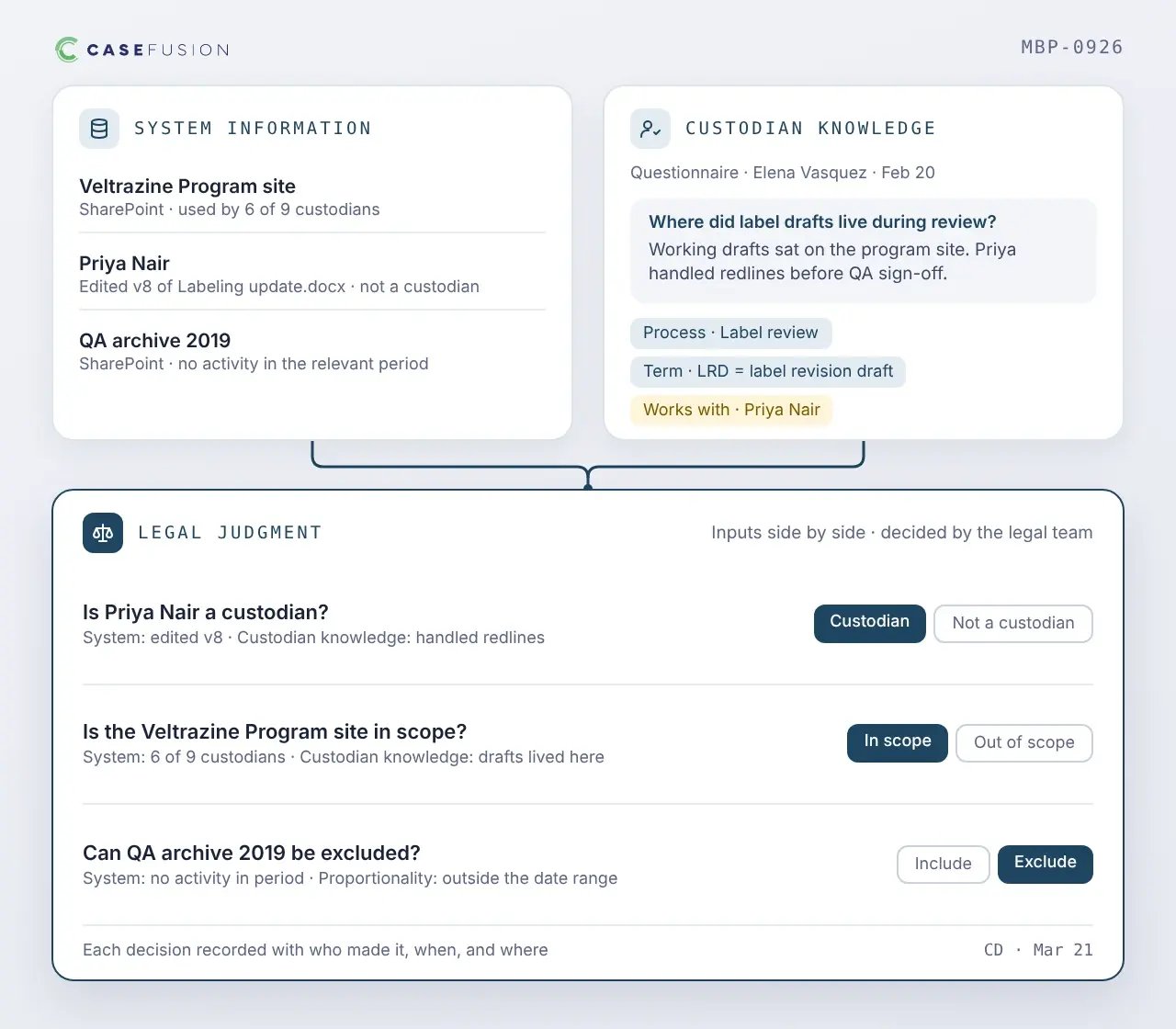
- Custodian knowledge | Business processes, informal working relationships, terminology, and matter-specific facts, gathered as structured information.
- Legal judgment | Whether a person is a custodian, whether a repository is reasonably in scope, what can reasonably be excluded, and how proportionality shapes the plan.
Identity over time
Current profiles show who a person is today, not necessarily the role they held during the relevant period.
Historical identity data shows who held a role, who managed the team, and when responsibility changed.
Names, addresses, and accounts from different systems may belong to the same person. If they are not connected, relevant ESI can be missed.
Match records to the correct person and keep uncertain matches separate. Missed matches can omit ESI, and incorrect matches can add unrelated data.
What each signal can and cannot tell you
Identification goes wrong most often when a legal team relies on one signal to settle a question it cannot support.
Membership and permissions show which sites and repositories a person could access.
Recorded activity can show interactions with files and repositories during the relevant period.
Custodians may not remember every repository, file, or interaction from the relevant period.
Permission does not show whether the person actually used the site or repository.
An audit event records an interaction, not its legal or business significance. Coverage depends on the activity retained.
Common identification scenarios
When the record and the starting assumptions differ, the context-aware response is to investigate, connect the evidence, and record the decision. A gap between what a custodian remembers and what the record shows is information to act on.
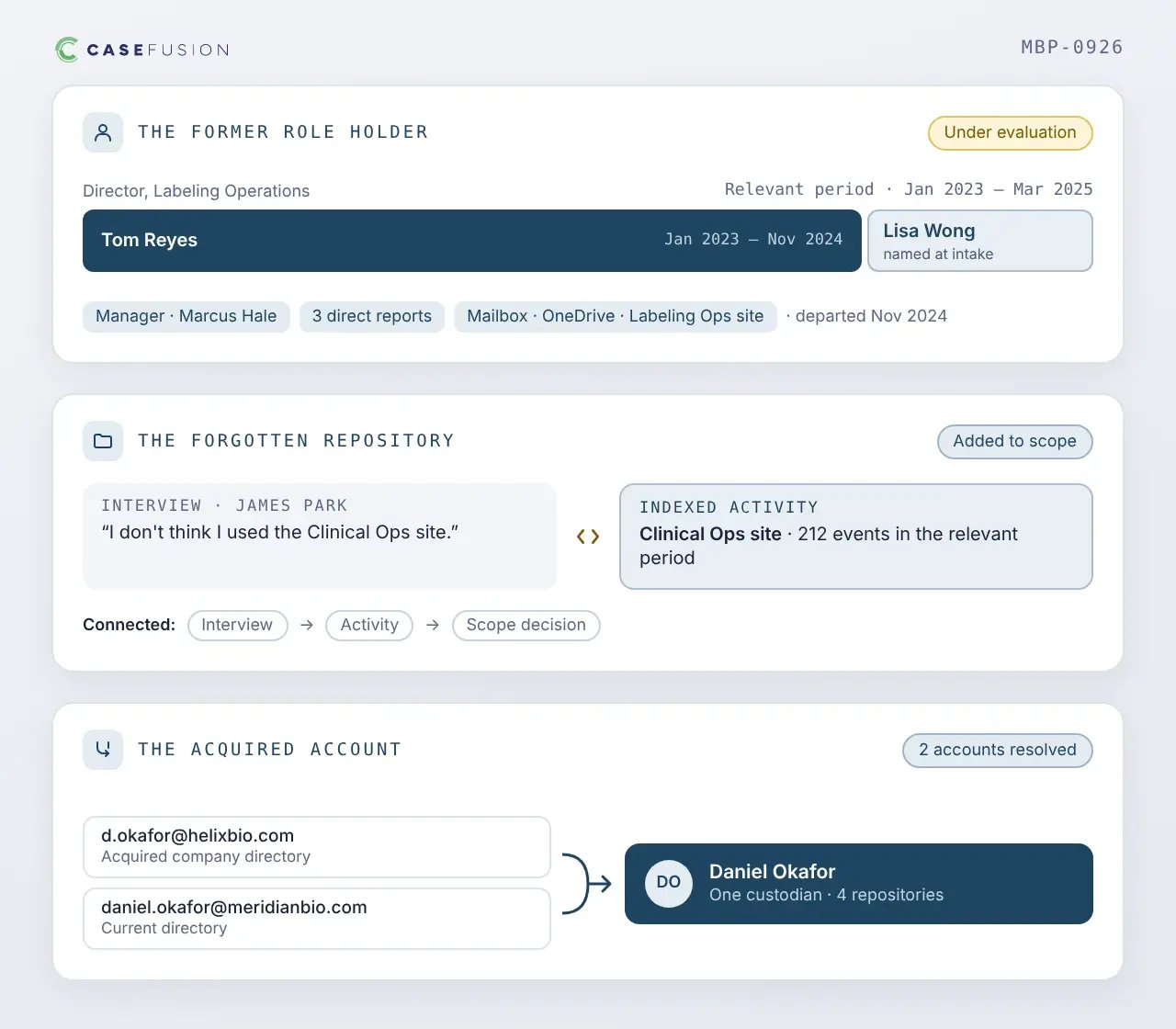
- The former role holder: Historical organizational information shows a different employee held the role through most of the relevant period. Evaluate that person with their manager, direct reports, and associated repositories, then decide what action is warranted.
- The forgotten repository: A custodian doesn't recall a SharePoint location that indexed activity shows they used repeatedly. Treat the difference as a prompt for investigation, and connect the interview, activity, and scope decision so the reasoning survives the matter.
- The acquired account: A custodian who joined through an acquisition holds ESI under an account from the acquired company's directory as well as their current one. Resolve both to the natural person so the repositories behind them belong to one custodian.
- The scope that reopens: Interviews surface people the list missed, activity surfaces repositories that went unmentioned, and collected ESI raises new questions. Each pass is recorded, so the matter keeps a history of what changed and why.
Carry identification decisions forward
Identification produces two things a matter needs later: a scope, and the reasoning behind it. Both are recorded during the matter, so the scoping decision can be explained afterward.- The scope moves into legal hold and preservation, where custodians and sources are protected and the record of what was included continues to build.
- Which custodians and sources were included or excluded, on what information, and when. Each later pass is recorded, so the matter carries a history of what changed and why.
Identify custodians & data sources FAQs
What is custodian identification?
Why is a current employee directory insufficient for identification?
Does CaseFusion decide who should be a custodian?
What is identity over time?
Do permissions show which repositories a person used?
Does an audit event establish that a file is relevant?
How do custodian interviews relate to system activity?
Does Cloudficient guarantee that every custodian and source will be identified?
Give every matter a better starting point
See how CaseFusion establishes who belonged to the matter when it happened, which sources they used, and why each one is in scope.