Skip to content
Contact Us
Background image

Understand your case before data moves downstream

Early case assessment should help a legal team understand the matter: who is involved, what happened, the potential exposure, and whether the collected ESI reflects the right scope. Too often, that assessment begins only after collection, when the content has been separated from the context that explains it.

Content alone may not explain the matter

Assessment tools begin with the collected documents. They search text, read metadata, identify topics and entities, analyze dates, group similar content, and estimate volume.

Links and versions

A message may point to a cloud-hosted file that was not collected, or the file may have changed after it was shared. The current version may not reflect the state associated with the communication.

Access and ownership

A file may sit in one employee’s OneDrive but be shared with or have recorded access events associated with others. A shared repository may also be owned by someone outside the initial custodian list.

Conversations

A chat message can mean one thing on its own and another within the conversation around it.

People and roles

A current job title may not reflect the role a person held when the communication occurred.

Investigate the preserved population

Early case assessment happens inside CaseFusion, against collected ESI, before any of it is committed to processing and review.

Read and search the population

Read supported ESI in place, including messages with their conversations and files with their version history. Work through the collected population by custodian, source, repository, date range, data type, participant, and content.

CONVERSATIONS Messages with the conversations around them
VERSIONS Files with their version history
ATTACHMENTS Linked files with the messages that referenced them
Analyze with context

Evaluate items alongside historical identity, repository activity, sharing and access relationships, and the scope decisions behind each source. Ask questions of a selected population in plain language, and investigate what comes back.

IDENTITY Roles people held at the time
ACTIVITY Repository use, sharing, and access
AI-ASSISTED QUERIES Plain-language questions of a selected population
Build the chronology

Assemble sequences of communications, documents, versions, and recorded activity across a period. Surface the people, communications, documents, and repositories that warrant closer attention.

CHRONOLOGY Events in sequence across a period
KEY PEOPLE Who warrants closer attention
KEY SOURCES Repositories central to the events

From content-only assessment…

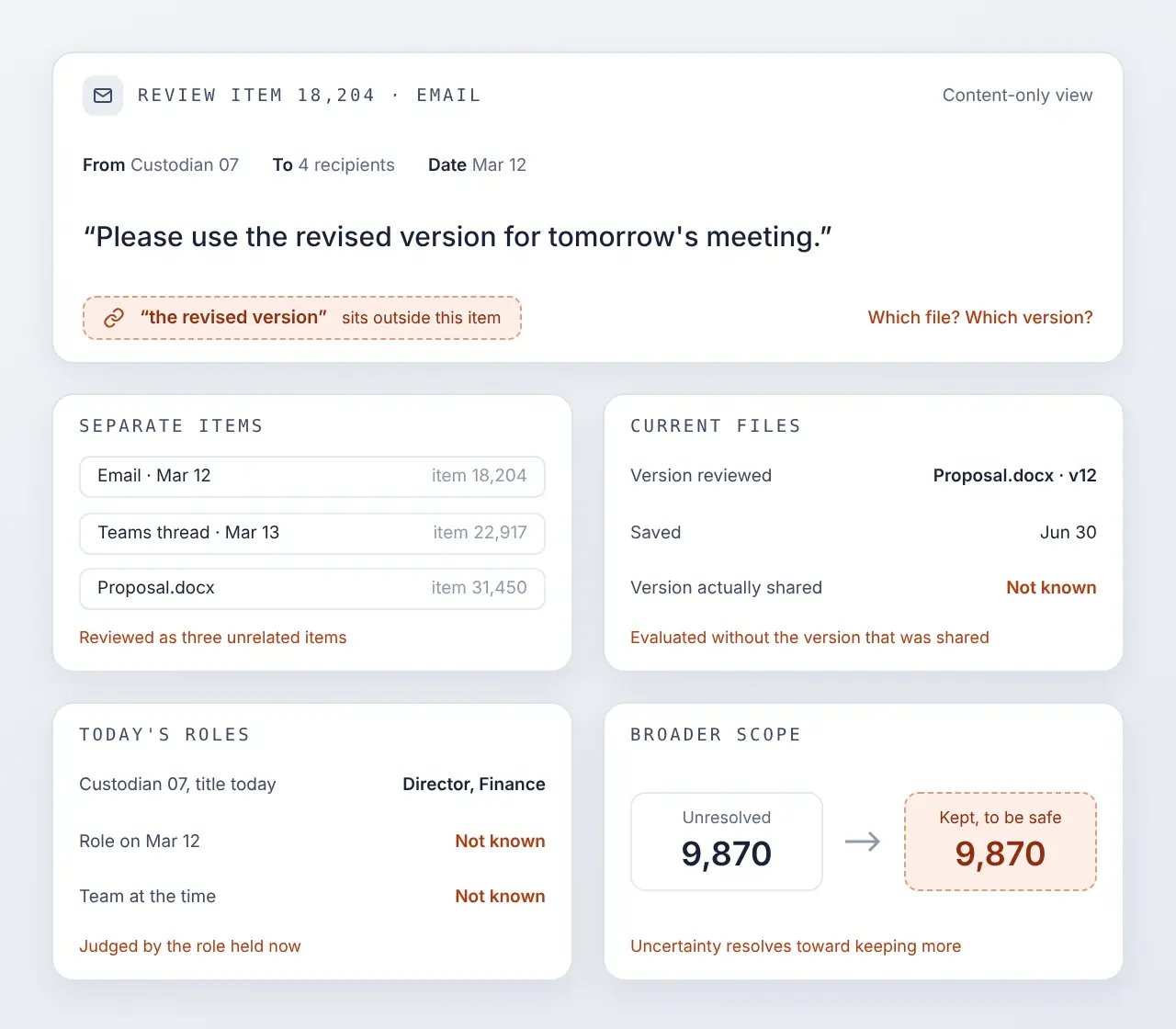
A message reads: "Please use the revised version for tomorrow's meeting." Content-only analysis establishes the sender, the recipients, the date, the message, and a reference to another document that sits outside the collected item.

  • Separate items | Related messages, files, and versions can be treated as unrelated items.
  • Current files | A current file is evaluated without reference to the version that was actually shared.
  • Today's roles | A person's role during the relevant period can differ from the one they hold now.
  • Broader scope | Where uncertainty remains, it tends to resolve toward keeping more.
from-content-only-assessment

… to assessment with context

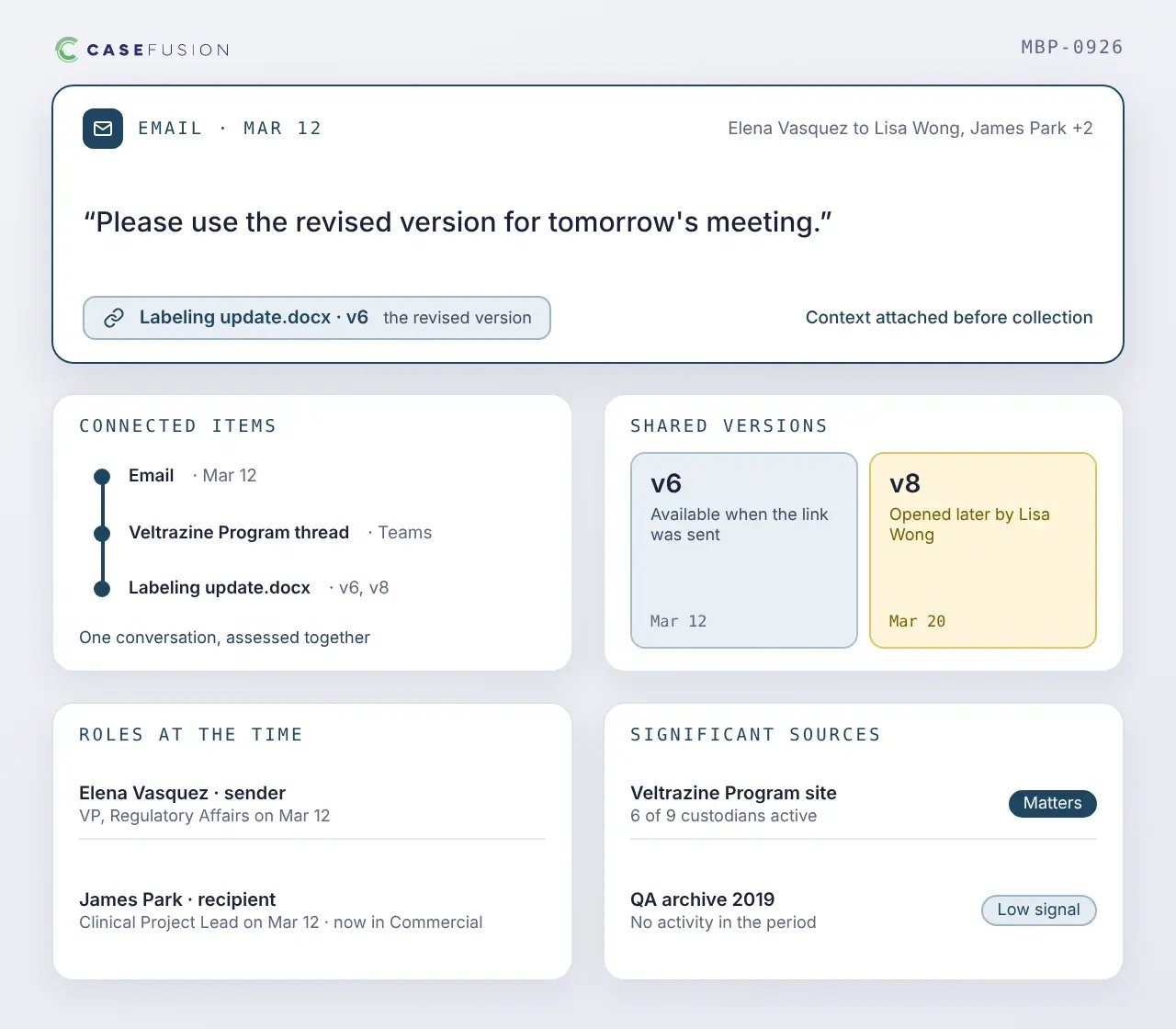
CaseFusion® assesses the preserved population with the matter still attached to it. Most of that context exists before a single item is collected.

  • Connected items | Communications stay connected to the files and versions they referenced.
  • Shared versions | The version available when the link was sent sits alongside a later version a recipient opened.
  • Roles at the time | People are evaluated by the roles they held when the events occurred.
  • Significant sources | Repository and activity information shows whether a source matters.
to-assessment-with-context

Validate the collection and refine the scope

Early case assessment should first confirm that the collection matches the matter. Check the custodians, sources, data types, date ranges, and volumes, then return gaps to identification or preservation.

A repository outside the initial scope

When analysis repeatedly surfaces a repository that was not identified earlier, return it to identification for investigation and a documented scope decision.

A person outside the custodian list

When analysis surfaces a person across relevant communications, return the finding to identification so the legal team can decide whether to add that person as a custodian and issue a hold notice.

Activity outside the date range

When analysis reveals relevant activity outside the initial date range, revisit preservation scope and decide whether the period should be extended. Record the change and its rationale.

Understanding your case earlier is a strategic advantage

Knowing what a case involves is worth more at the beginning than at any later point, because the beginning is when the most consequential decisions are still unmade.

Negotiate from what you know

Enter meet-and-confer discussions with a clearer view of the people, sources, and issues, and negotiate the ESI protocol from information already established.

Shape strategy earlier

Use early findings to inform litigation posture, exposure analysis, mediation, and settlement strategy while those decisions remain open.

Prepare interviews and test scope

Use early findings to focus custodian interviews and test whether preservation covers the right people, sources, and time periods while scope can still be adjusted.

Understand before costs accumulate

Assess the population before sending it to downstream review and incurring hosting and review costs.

Reduce volume you can explain

The result may not be smaller. It is a population chosen deliberately, with its relationships intact and the reasons for inclusion, exclusion, and scope changes recorded.

A record of every decision

Better information produces a population the legal team chose deliberately, and a record of why, whether or not it ends up smaller, with conversation and document relationships kept intact.

Works alongside Microsoft 365 review

Native review sets in Microsoft 365 analyze the content that was collected. CaseFusion analyzes that content together with the information the collection was built from.
price-cards-1 microsoft-purview-seeklogo
What Microsoft 365 review sets analyze
  • The content that was collected
  • Text and metadata in the review set
price-cards-2 case-fusion-logo
What CaseFusion adds
  • Identity: the roles people held at the time
  • Activity: repository use, sharing, and access
  • Relationships: the files, versions, and conversations around each item
  • The reason an item is in the matter at all

Early case assessment & review FAQ

What is early case assessment?

Early case assessment is the process of evaluating a matter's facts, people, exposure, and data population early enough for that understanding to shape strategy and scope, rather than after the population has been processed and loaded into a review platform. 

What is Context-Aware early case assessment?

It is early case assessment performed on collected ESI with the matter context still attached - historical identity, repository and activity context, cloud attachments and selected versions, conversation relationships, and the scope decisions behind them - so items are evaluated as part of a matter rather than as isolated documents.

How is this different from traditional early case assessment?

Traditional early case assessment analyzes content after collection has separated it from most of what explains it. The Context-Aware approach keeps those relationships attached, so the same content can be evaluated against who was involved, what role they held, where the ESI came from, and which version was tied to which event. 

How is this different from native Microsoft 365 review sets?

Review sets analyze the content that was collected. CaseFusion analyzes that content together with the identity, activity, and relationship information the collection was built from, which is what explains why an item is in the matter at all. 

Does AI determine which documents are relevant?

No. AI-assisted queries help a legal team investigate a collected population and surface patterns. Relevance, responsiveness, and privilege are legal determinations made by the legal team, and results should be reviewed and validated before informing a material decision. 

What is defensible culling?

Reducing the data population through a process that is reasonable, tested, documented, and explainable. The defensibility is in the process and the record behind it, not in the size of the result. 

Does culling always produce a smaller population?

No. Better information sometimes shows that a population should be larger, or differently composed. What it reliably produces is a population the legal team chose deliberately and can explain. 

Can ESI stay preserved without moving into review?

Yes. Early case assessment works against the collected population, and ESI that is not promoted to review remains preserved under the matter's preservation strategy. 

Can early case assessment identify missing data?

Yes. Confirming that expected custodians, sources, data types, and date ranges are represented is one of the first things a legal team should do, and a gap found there is a finding about scope rather than about the data. 

Can selected ESI be sent to a downstream review platform?

Yes. Early case assessment determines what moves forward; the selected population is then made available for downstream processing and supported review workflows. CaseFusion does not replace a review platform. 

Assess the case before the population moves downstream.

See how CaseFusion supports early case assessment as part of the matter rather than as a stage after it.