

Move operational data the divested business still needs into the buyer’s production environment.

Preserve required data through acquisitions and divestitures
Maintain information subject to continuing legal and governance obligations while acquired environments are integrated, divested environments are separated, and the business reaches its intended technology state.
Data obligations outlast the transaction
A transaction follows fixed milestones. The legal and governance requirements attached to acquired or divested data follow their own timelines and may continue long after close.
Signing, close, system separation, and integration each follow defined milestones.
Open matters, unexpired retention periods, regulatory requirements, and client or contractual responsibilities may continue long after the transaction closes.
Legal, Information Governance, and IT must carry those requirements forward even after the transaction work is complete.
If obligations are addressed only after systems are scheduled for retirement or separation, the organization may need to extend access, revise the migration, or reconstruct context later.
Inherited obligations become inherited infrastructure
An acquisition brings systems, data, and continuing obligations. Unless required populations can be separated from the environments holding them, the integration inherits the infrastructure as well.
An acquisition may bring archives, Microsoft 365 tenants, file shares, collaboration platforms, directories, and messaging systems. Specific populations may remain subject to continuing requirements even when the system has no remaining business use.
When required populations cannot be separated, the organization may keep the entire inherited environment running for a subset of its data.
Expireon™ provides an independent, governed environment for information that must remain. After the preserved population is validated and approved, inherited systems can proceed toward decommissioning without waiting for the longest obligation to end.
Separate the business without losing required access
In a divestiture, systems, employees, and operational data may transfer to the buyer while the seller retains legal, regulatory, contractual, or governance requirements tied to historical information. The data plan must give each party appropriate access without leaving either dependent on the other’s systems.
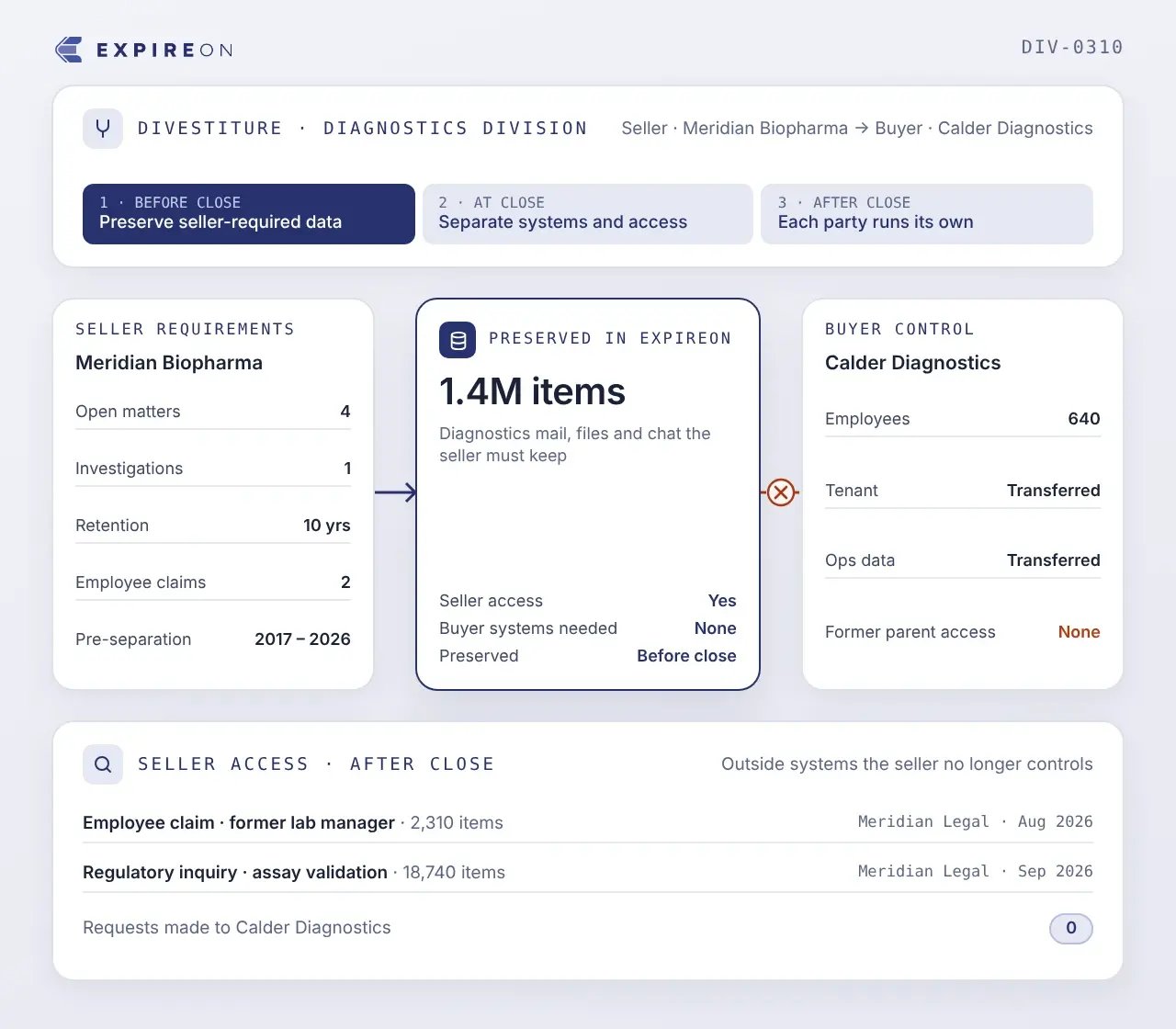
- Seller requirements | Open matters, investigations, retention requirements, employee claims, and pre-separation activity
- Buyer control | No standing access from the former parent to transferred systems
- Seller access | Required historical information remains available outside systems the seller no longer controls
- Separation approach | Preserve seller-required information independently before systems and access are separated
Keep data from extending the TSA
A transition services agreement (TSA) has a defined end date, but continued access to historical information can extend the dependency. Preserving required information before separation helps each party meet its requirements without relying on the other’s environment.
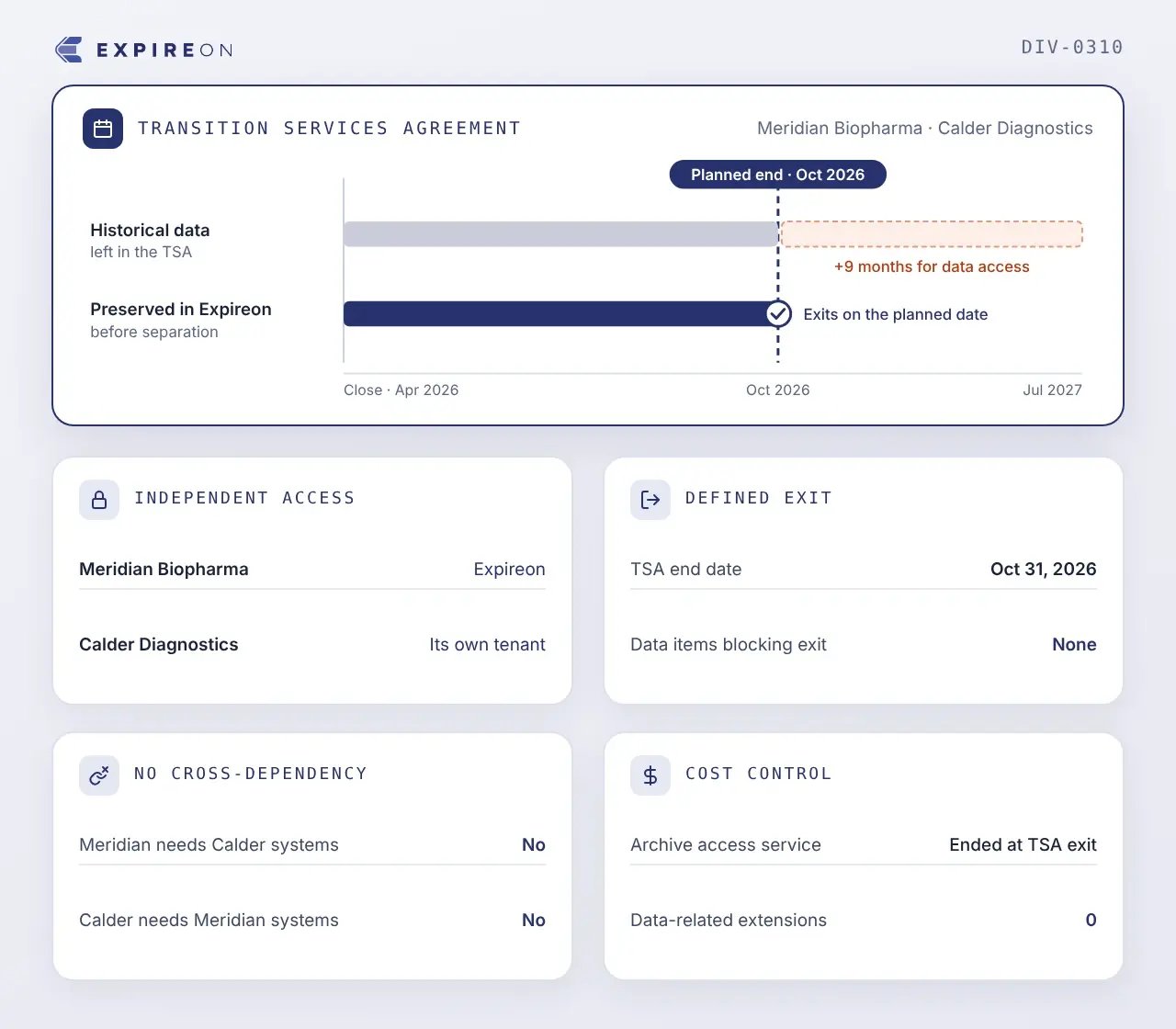
- Independent access | Each party uses an environment it controls
- Defined exit | Data access no longer determines the TSA end date
- No cross-dependency | Neither party relies on the other’s systems for required historical information
- Cost control | Fewer data-related reasons to extend the agreement
Give each population the right destination
A single source environment may hold information that belongs with the buyer, information the remaining business still needs, information that must stay preserved, and information ready for disposition.
Move data needed for continuing operations into the acquirer’s or seller’s production environment.
Preserve information subject to continuing legal, regulatory, client, or contractual requirements in Expireon™, outside both parties’ production environments.
Allow data with no continuing business, legal, regulatory, client, or governance requirement to expire or proceed to disposition through an approved process.
Keep historical identity intact through the change
Preserving identity and source information during the transaction, while the mapping is still knowable, costs far less than reconstructing it during a matter three years later.
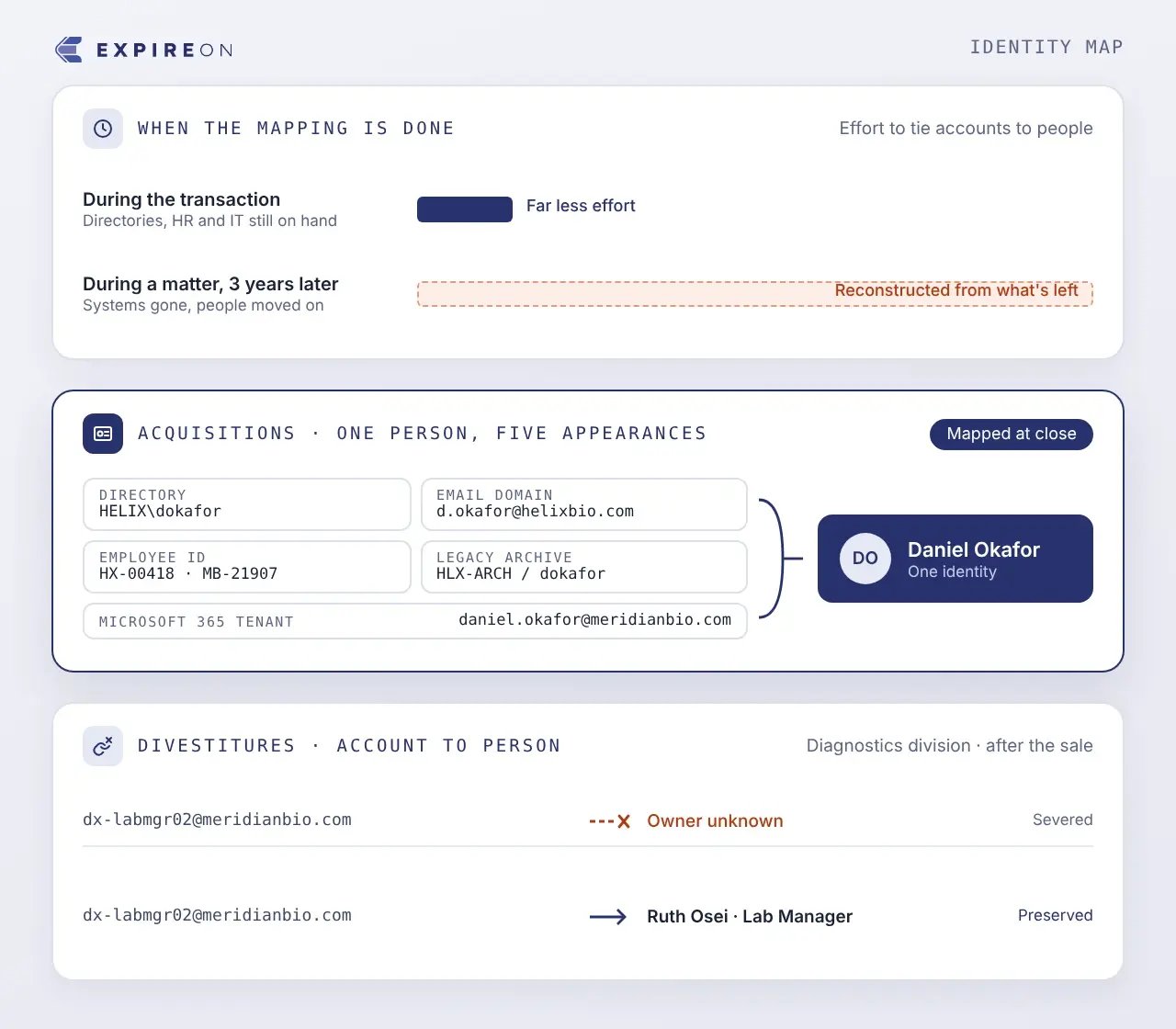
- Acquisitions | The same person can appear differently across corporate directories, email domains, employee IDs, legacy archives, and Microsoft 365 tenants.
- Divestitures | The connection between a historical account and the person who used it can be severed, leaving accounts that make future discovery slower and more expensive.
M&A and divestiture data preservation FAQs
What is M&A and divestiture data preservation?
What happens to legal holds during a divestiture?
Can an acquirer retire the systems it inherits?
Why do transitional service agreements extend past their planned end date?
After a divestiture, who keeps the historical data, the buyer or the seller?
Preserve required data without extending the transition
See how Cloudficient can preserve information subject to continuing obligations, remove the data dependencies that keep inherited and separated systems alive, and help Legal, Information Governance, and IT reach the transaction's intended operating state.
