Bring complex data into Expireon with its context intact
Ingest historical, journal, and transition data while preserving the available metadata, identity, source information, and relationships needed for future legal and governance use.
What must survive the transition
Information that survives a transition should remain understandable after it leaves the source. Different systems expose different metadata and represent relationships differently, so the source matters as much as the platform.
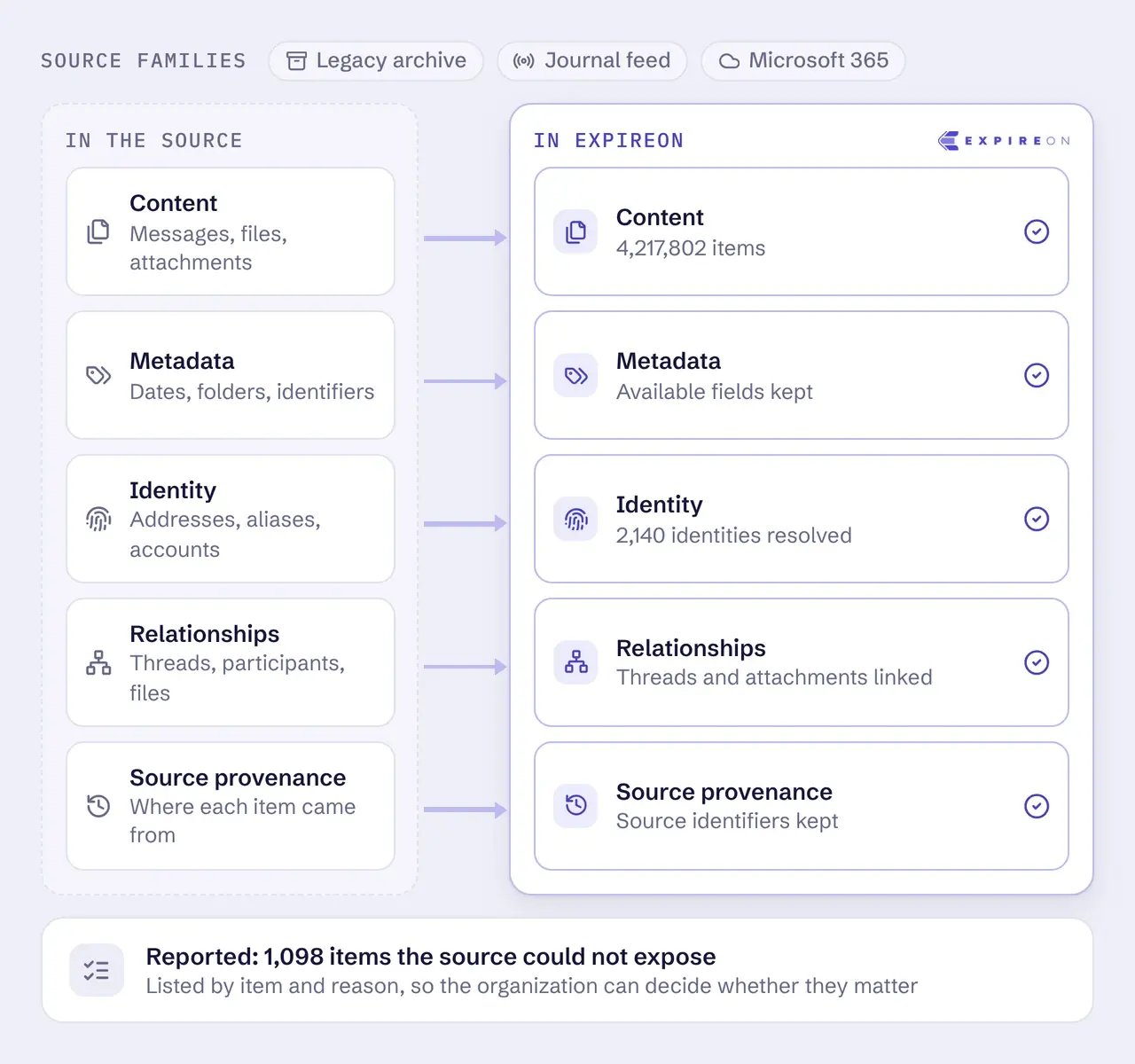
Expireon preserves what the source makes available and reports what it cannot.
- Content | Supported messages, files, attachments, and other source content.
- Metadata | Available dates, identifiers, properties, folder and repository attributes, and other source metadata that later search and interpretation depend on.
- Identity | Supported associations among historical addresses, accounts, aliases, employee identities, and other identity information.
- Relationships | Supported connections among messages, participants, attachments, files, conversations, and other related objects.
- Source provenance | Where the data came from, with available source identifiers retained so the ingested population can be traced back to its origin.
- Preservation information | Supported legal hold and preservation status, carried forward where the ingestion workflow requires it.
Preserve the context that makes content
Legacy and transition data depend on more than the files and messages themselves. Historical identities, source metadata, participants, repository structure, attachments, relationships, and legal status help explain what the population contains and how it can be used.
A bulk transfer may preserve file counts while losing the context needed to interpret the population. The gap often becomes clear only when the information must be searched, governed, or prepared for disposition.
Expireon™ ingests legacy and transition data into a governed environment while retaining the identity, metadata, relationships, and source context available from each system. The information remains understandable and usable for future access, governance, and disposition.
Where the data comes from
Expireon receives data from systems that are retiring, systems that are changing hands, and systems that are still running.
Legacy archives and historical files
Historical email and archive populations from systems being retired or consolidated, along with supported historical file and document populations.
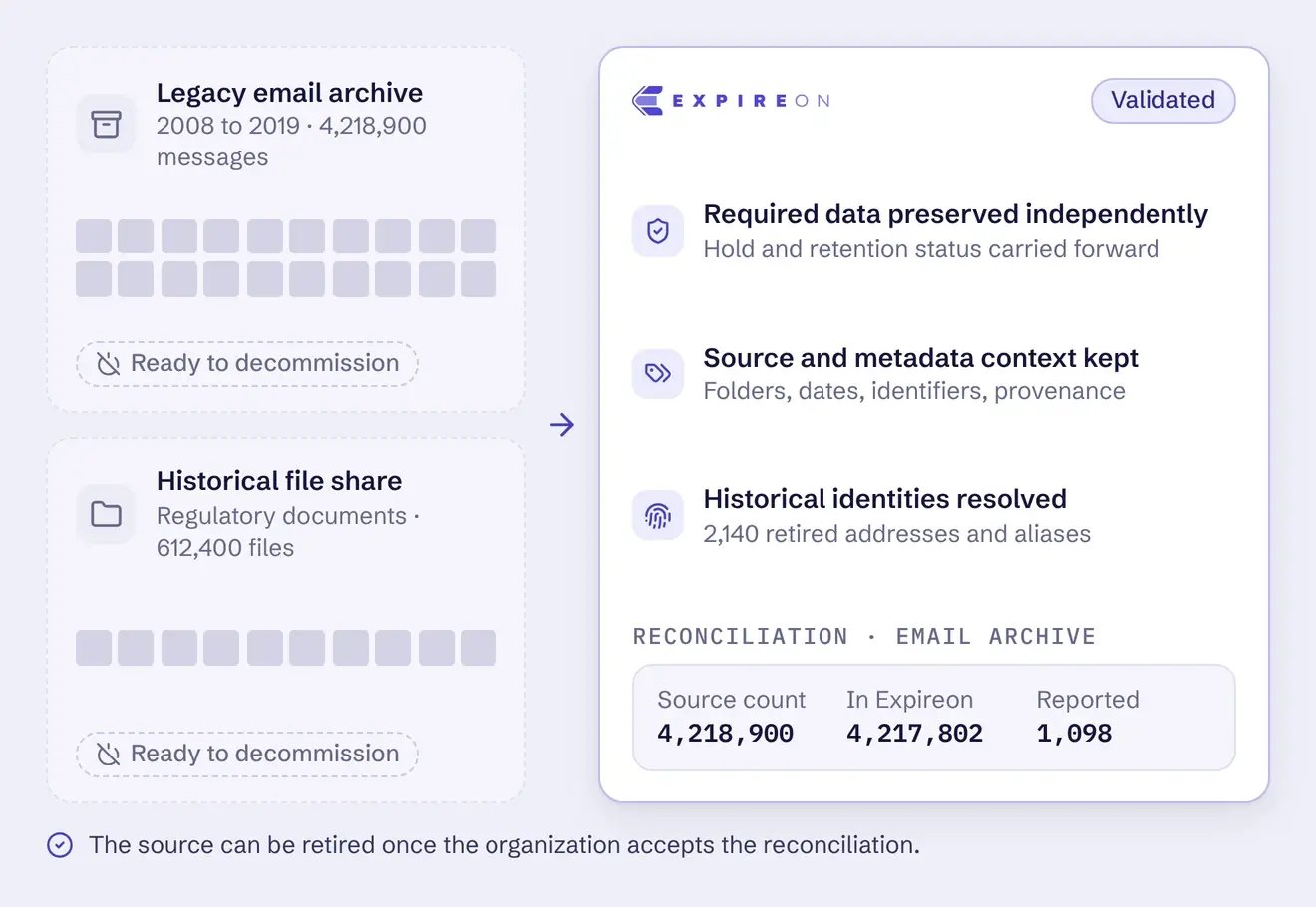
- Legacy archives | Preserve required data independently of the legacy infrastructure so the source can be decommissioned.
- Files and repositories | Maintain available source and metadata context while bringing content into a governed environment.
Inherited and departing populations
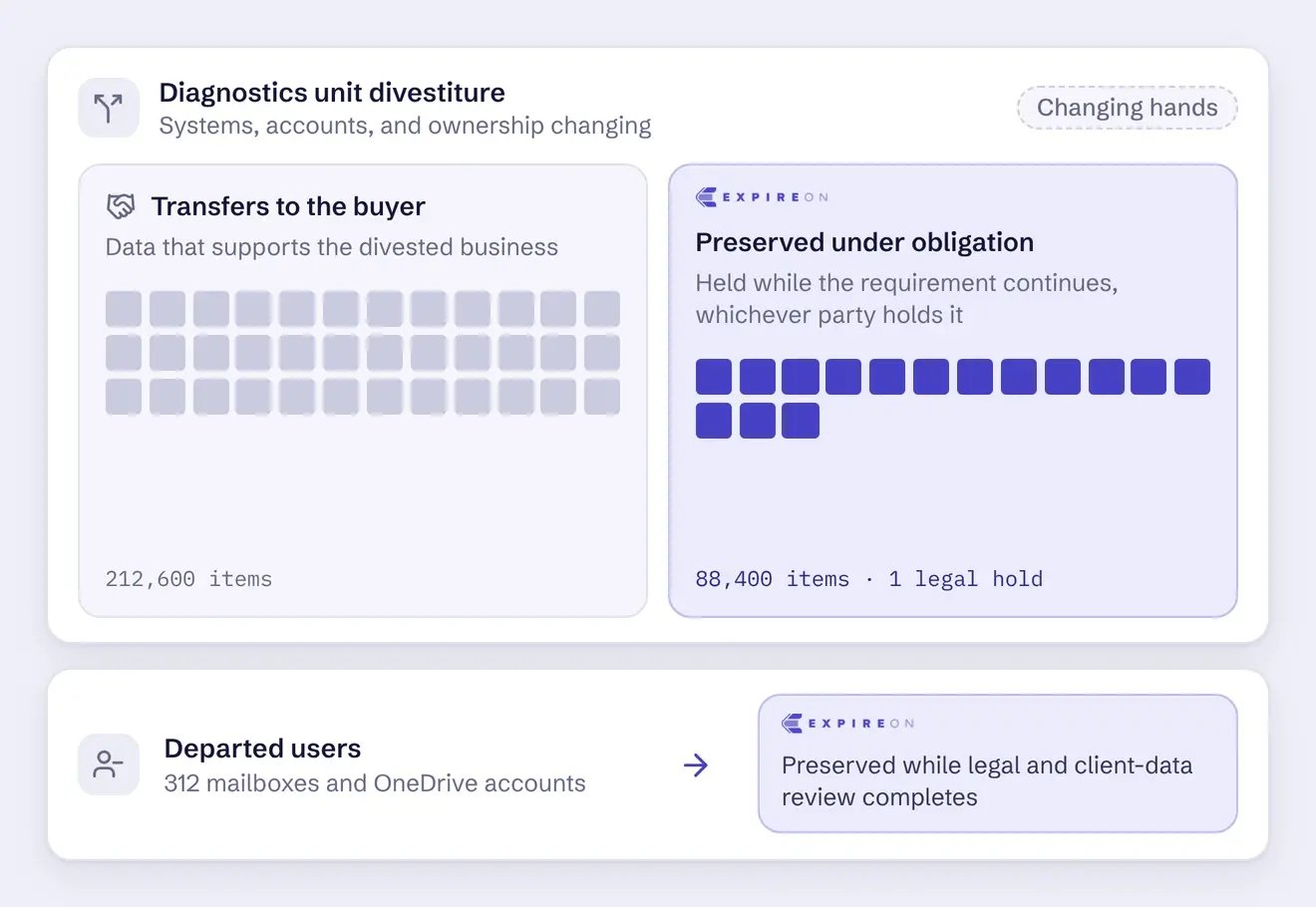
Inherited, separated, or transition populations, along with mailboxes, files, and other supported account data from departed users.
- M&A and divestiture data | Preserve data while ownership, systems, accounts, and operating structures change.
- Departed-user data | Preserve information while the organization completes legal, governance, or client-data review.
Ongoing and active sources
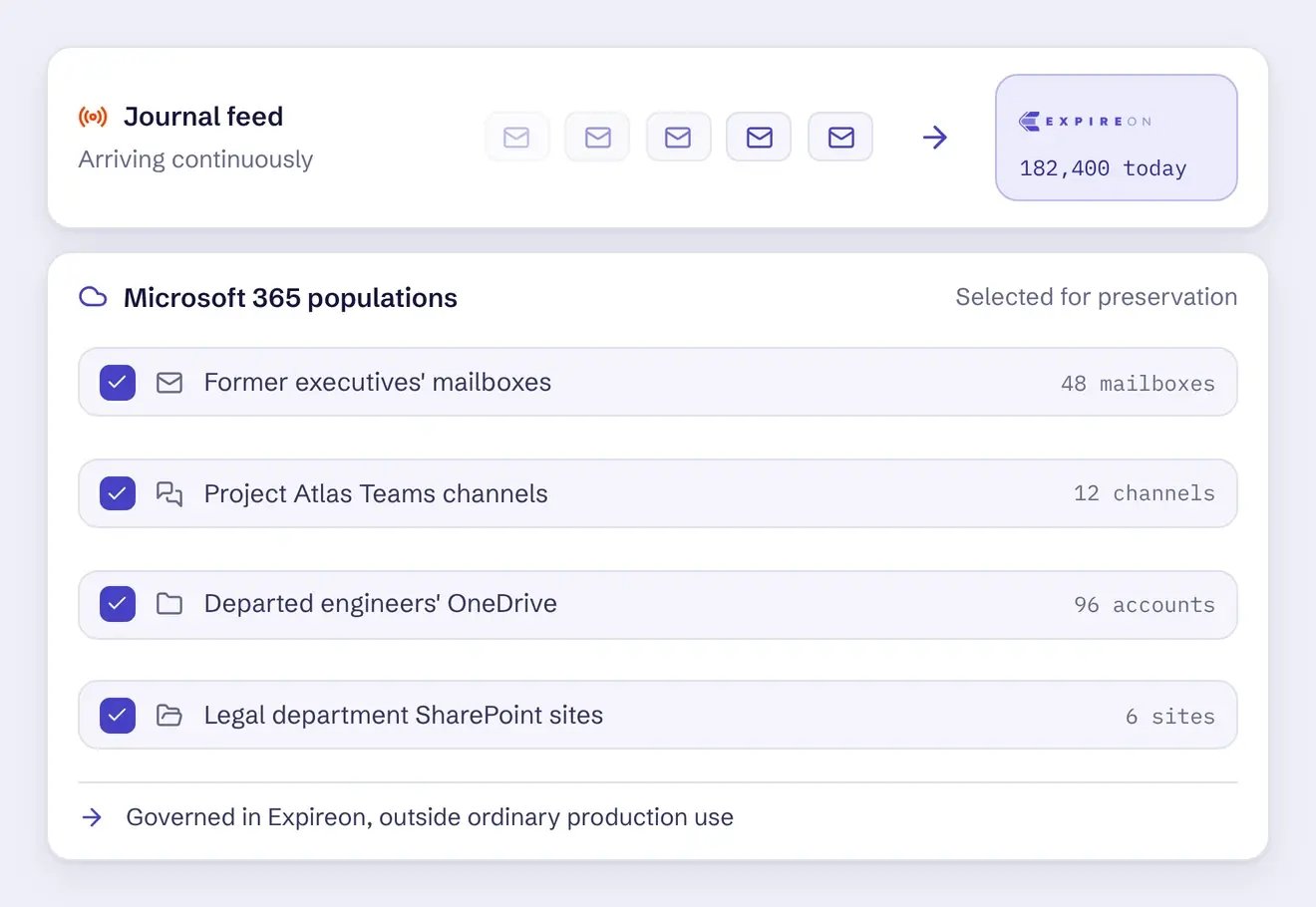
Ongoing journal email delivered into Expireon, along with supported mailbox, file, or collaboration data collected for preservation or transition.
- Journal feeds | Create a continuously governed population that supports classification, preservation, search, and future review.
- Microsoft 365 populations | Keep selected information governed outside ordinary production use.
What ingestion includes
Ingestion brings supported data into Expireon™ while retaining the available identity, source, metadata, and relationship information that keeps the population understandable. It supports the Preserve and Understand stages of Legal Data Continuity before the information is triaged, transitioned, and governed.
Establish the approved connection, feed, export, or transfer path for the population.
Retrieve supported content and the identity, metadata, and relationship information available from the source.
Convert source-specific information into a consistent structure while retaining the context needed to interpret it.
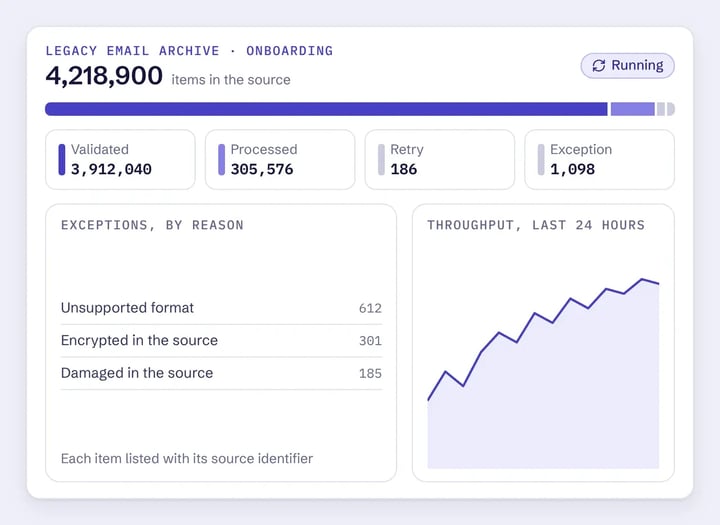
Reconcile the ingested population against available source counts, identifiers, exceptions, and metadata before the organization changes its reliance on the source.
Maintain the validated population and its source context in Expireon so the information remains searchable and available for future governance.
Because systems represent email, files, identities, folders, conversations, and metadata differently, Expireon normalizes supported data for consistent governance while retaining available source-specific information and provenance.
-
Scale and continuous feeds | Automated processing of high-volume archive and file populations without item-by-item handling, and ongoing ingestion where data keeps arriving rather than landing once
- Exceptions and visibility | Identification and reporting of items that cannot be processed as expected, with progress, throughput, and exception information for the teams running the program.
Keep track of the people behind old accounts
Historical data refers to people through addresses and accounts that have since changed. Old email addresses, aliases, employee identifiers, acquired directories, and departed accounts all appear in the record, and none of them resolve against the directory that exists today.
The gap surfaces at the worst possible moment. A preservation request names a custodian, and the data that belongs to that person is filed under an address the organization retired six years ago, an identifier inherited from a company it acquired, or an account that closed when the employee left.
Expireon associates supported historical identity information with the ingested data, so later search, preservation, export, and investigation are not limited to the current state of the directory. Historical data is easier to use when the organization can still identify the people behind retired accounts and addresses.
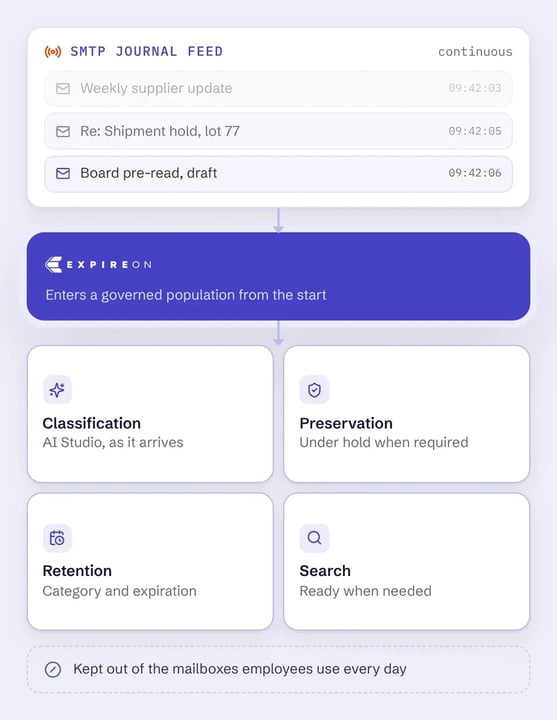
Expireon receives journal email as a continuous feed, not only as a historical population extracted from a system that is shutting down.
-
A journal feed delivered into Expireon enters a governed population from the start, rather than waiting for a migration, investigation, or preservation event.
- Classification models trained on the organization's own examples run against the feed as it arrives, and the same models apply to historical email already preserved.
It also gives journal data a destination that is not the production environment. Journal populations rarely belong in ordinary mailboxes, and keeping them in a governed continuity environment separates them from the collaboration platform employees use every day
Validate before the source goes away
Ingestion quality is essential for Legal Data Continuity. Expireon provides auditable validation so legacy systems can be retired, access can be changed, and populations can be removed from production with confidence.Compare available item counts across the transition.
Reconcile known source identifiers where the source supports them.
Record failed, skipped, and unsupported items rather than passing over them.
Validate representative metadata and attachment relationships against the source.
Document processing and transfer exceptions as they occur.
Give technical and governance teams what they need to decide whether the transition is ready to proceed.
Choose the right destination for each population
Migration moves active or required business data into its next production environment. Expireon™ ingests and preserves information that must remain searchable and governed outside production. When a source contains both, a combined program routes each population according to its continuing purpose and requirements.
Move active or required business data into the production environment where it will continue to be used.
Ingest information that must remain preserved, searchable, and governed outside production without keeping the source environment in place.
Separate a mixed source population into data that should move to production, remain preserved, transition elsewhere, or proceed to disposition.
Ready to preserve, search, classify, and export
The goal of ingestion is a population the organization can act on, which means the onboarding process has to prepare the data for the work that follows.Preserved source and item metadata locates and filters relevant populations.
Content is indexed where required so authorized users can search message and file text.
Trained classification models apply to eligible email, including historical populations and ongoing journal feeds.
Defined populations are associated with continuing legal and governance requirements.
Selected information moves to review tools, a DMS, production platforms, counsel, or another approved destination.
Retained data is managed against retention requirements, with legal hold status accounted for before anything is disposed of.
Legacy data ingestion FAQ
What is Expireon Data Ingestion?
What is legacy data ingestion?
How is ingesting data into Expireon different from migrating it?
Can Expireon ingest data continuously?
How do you know a legacy archive migrated correctly?
What happens to old email addresses when historical data is preserved?
Know what must survive before you turn off the source
Bring us the environment you are trying to retire, separate, or bring under governance. We will show you what Expireon can ingest from it, what metadata and identity information will survive the move, and what the validation reporting will tell you before you change what you depend on.