Skip to content
Contact Us
Background image
EXPIREON™ AI STUDIO

Classify incoming and historical email

Train classification models on your own examples, apply them to live journal feeds and to historical email already preserved, and use the results to prioritize review and inform preservation, retention, and disposition decisions.

Classification is worth more when it already exists

Waiting creates a deadline

When classification begins after a matter, investigation, or migration is underway, teams must first understand the population when time is already limited.

Classify as email arrives

AI Studio applies machine-learning-assisted classification to a live journal feed, creating an organized view of email before a specific review is required.

Train for your organization

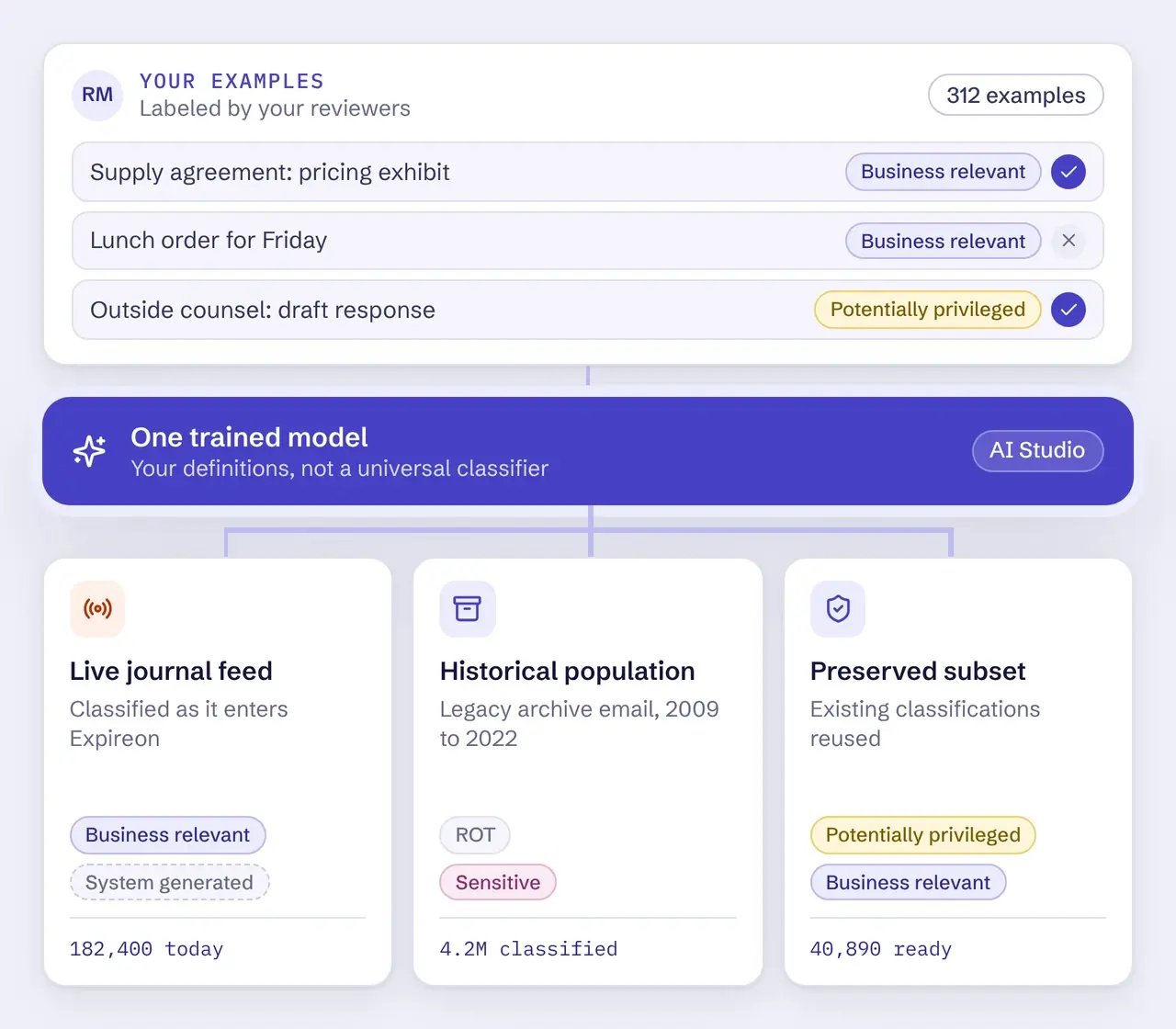
Organizations define business categories differently. Reviewers provide examples from their own communications, and AI Studio trains the model on those examples.


Apply the model across time

Once trained and validated, the same model can classify newly arriving journal data and historical email already preserved in Expireon.

The same model applies to live and historical email

AI Studio is not a one-time analysis of legacy data. The same trained model applies to email the organization already holds and to email that keeps arriving. 

  • Live journal feed | Classifies email as it enters Expireon, so business relevance, sensitivity, potential privilege, and other configured categories are available early rather than assembled later.
  • Historical population | Applies the same trained model to existing email collections so older data can be segmented, reviewed, preserved, or governed without reading it message by message.
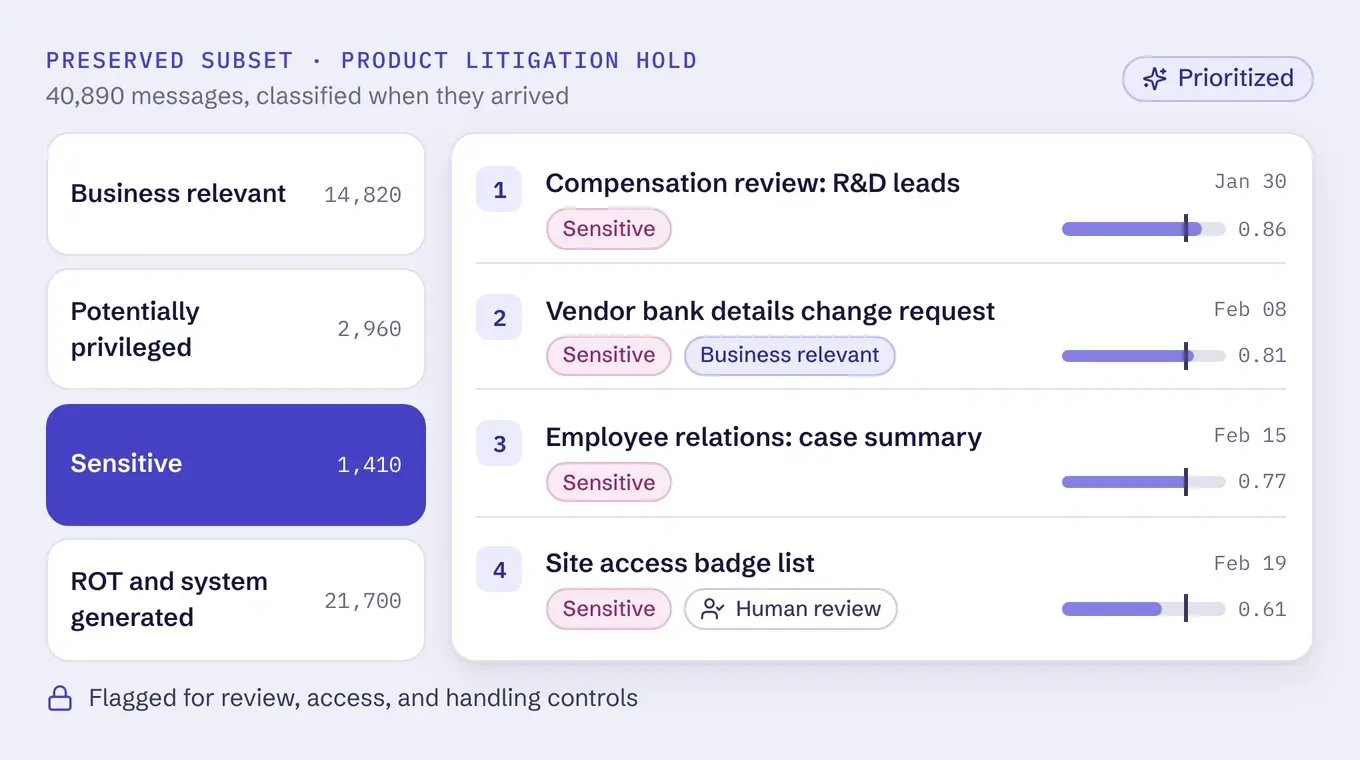
  • Preserved subset | Uses existing classifications when a population is preserved for a legal matter or another continuing requirement, so reviewers can start with the messages most likely to warrant attention.
eo-ai-studio-01-live-and-historical

How AI Studio works

AI Studio applies a model trained on the organization’s own examples to live journal data, historical email, and preserved email populations. Classification helps the organization understand the data; policy and accountable reviewers determine what happens next.

Define

Define the email population, classification categories, training objectives, and how the results will be reviewed and used.

Train

Train the model on examples selected and reviewed by the organization’s own people.

Classify

Apply the trained model to live journal data, historical email, or a preserved email population in Expireon.

Review

Evaluate results against configured confidence thresholds and route uncertain items for human review or optional secondary analysis.

Apply

Use reviewed classifications to focus review, segment exports, and inform preservation, migration, retention, and disposition decisions.

Configure the Thresholds

Set confidence thresholds based on the organization’s risk tolerance, policies, and intended use.

Meets the Threshold

Results that meet the configured threshold become available to the workflow they were designed to support.

Falls Below the Threshold

Route low-confidence items to human review, additional analysis, or optional LLM-assisted secondary review.

Optional LLM-Assisted Review

Use an optional LLM-assisted step to examine low-confidence results before a person decides how they should be handled.

What AI Studio classifies

AI Studio applies machine-learning-assisted classification to supported email populations in Expireon. Categories are model outputs that support review and governance decisions. They are not legal conclusions.
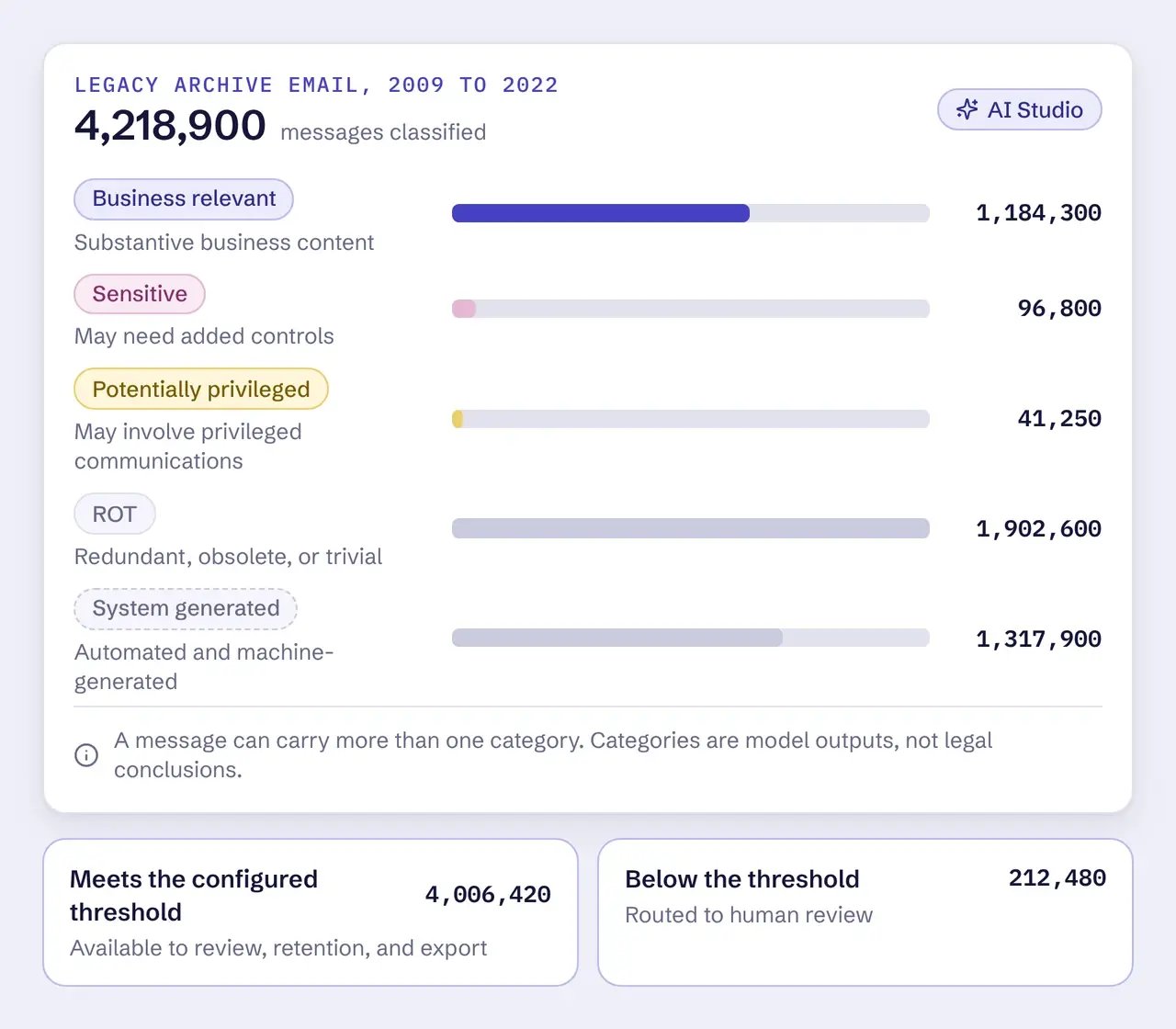
  • Business relevant | Email that appears to contain substantive business content and may deserve priority in review, preservation, migration, or retention workflows.
  • Sensitive | Content that may warrant additional controls or prioritized review because of the nature of the information.
  • Potentially privileged | Email that may involve privileged communications, so reviewers can prioritize it for legal assessment. AI Studio does not make privilege determinations.
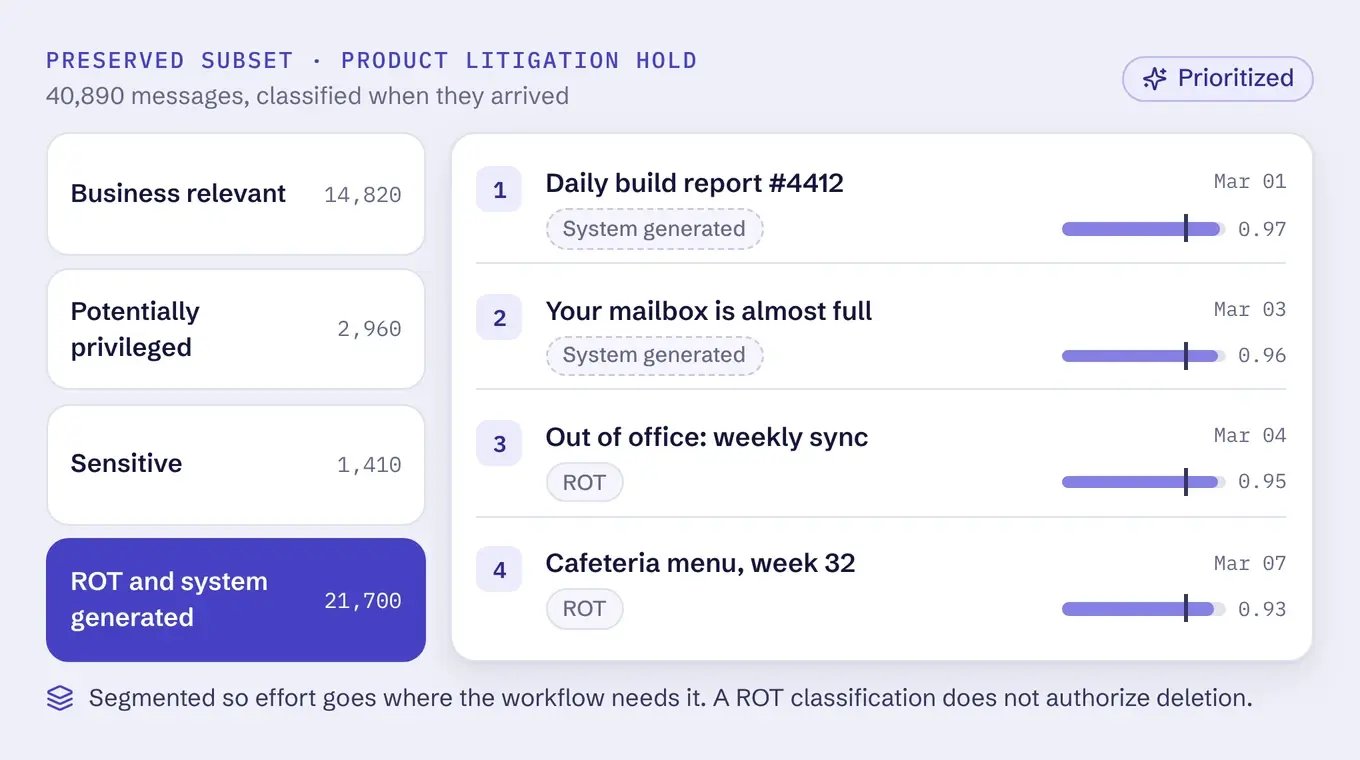
  • ROT | Redundant, obsolete, or trivial content that may warrant less attention or further policy review.
  • System | Automated and machine-generated email, separated from ordinary human business communications.
eo-ai-studio-02-what-it-classifies

Start review with the messages most likely to matter

Classification earns its value when a population has been preserved for a legal matter or another continuing requirement and someone has to decide where to begin.
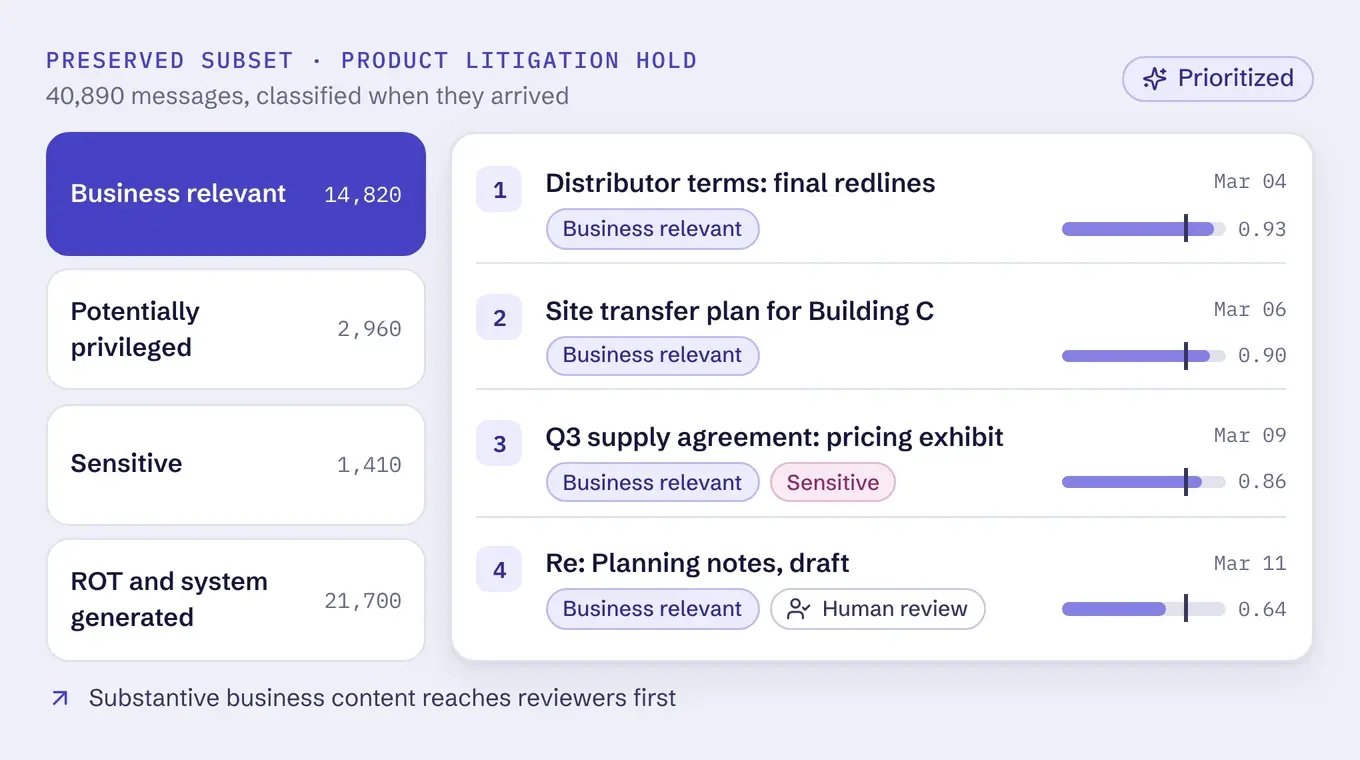
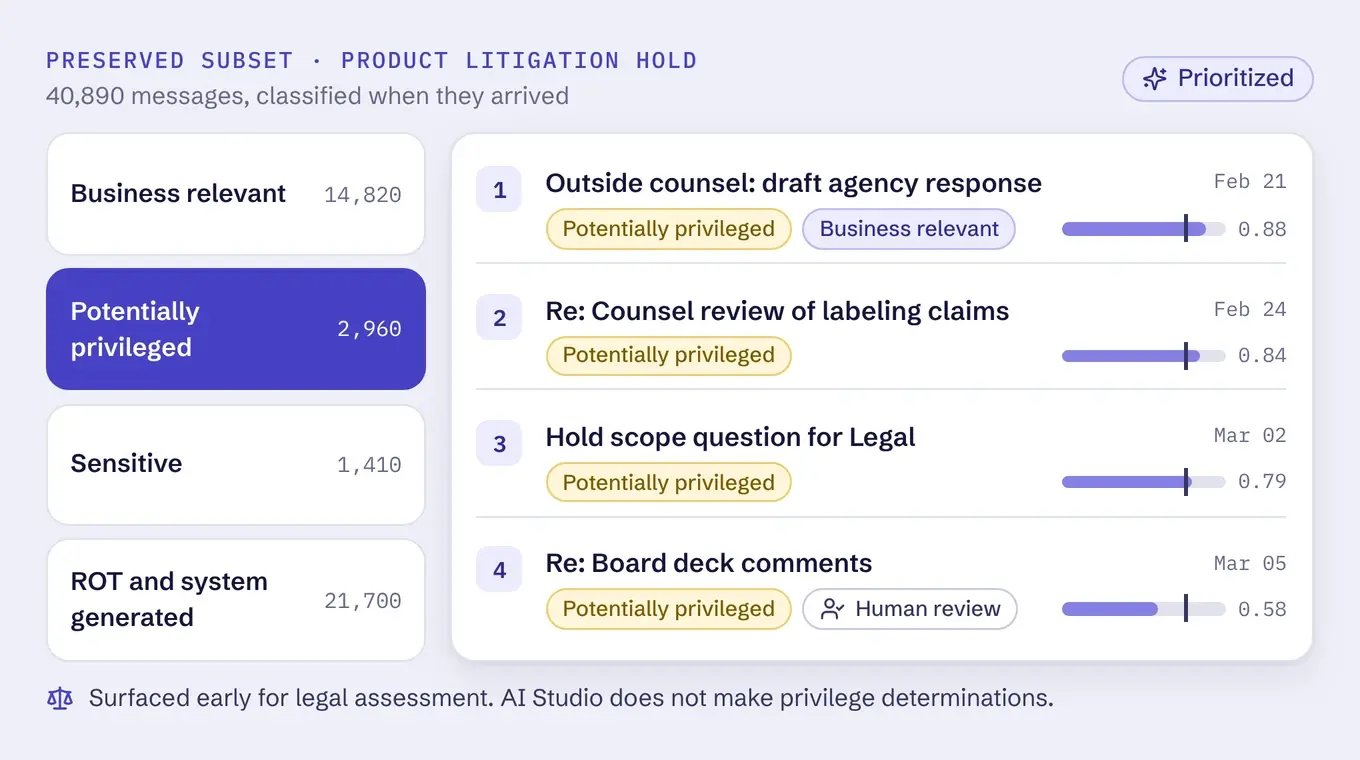
Business relevant classification

  • How it influences review | Prioritizes email that appears to contain substantive business content.
  • What it is worth | Directs reviewers toward messages more likely to inform the matter or the preservation decision.
eo-ai-studio-03-tab-business-relevant

Classification with clear guardrails

Use classification to focus review effort without giving the model authority over the legal decision.

Focus review effort

AI Studio classifies and segments email so teams can direct attention where it is needed.

People make the decisions

Preserve connected ESI that may live outside a custodian's own account.

Classification does not authorize deletion

A ROT classification can identify content for further review. Disposition depends on applicable legal holds, regulatory, contractual and client requirements, records schedules, and approved governance policies.

Confidence is configured and validated

Confidence thresholds are configured for the organization’s use case, and model results are validated against its own data. AI Studio does not claim absolute accuracy.

Where AI Studio is used

Archive retirement

Classifies historical email before the organization decides what remains preserved, what moves elsewhere, and what becomes eligible for disposition analysis.

M&A and divestiture

Applies the trained model to inherited or separated populations so teams can assess what they received before determining future states.

Platform migration

Distinguishes historical email that belongs in the next production platform from email that should remain preserved, instead of moving everything because nothing has been evaluated.

Attorney transition

Prioritizes preserved attorney email for review, while client and matter identification remains a separate governance process the firm controls.

Continuous journal preservation

Classifies email continuously as journal data enters Expireon, so future governance and legal workflows start from a classified population.

AI Studio FAQs

What is Expireon AI Studio?

Expireon AI Studio is an AI-assisted email classification capability that uses models trained on the organization's own examples, configurable confidence thresholds, and optional LLM-assisted review to classify live journal feeds, historical email, and preserved populations, so teams can prioritize review and support governance decisions. 

Can AI classify email for legal review?

AI-assisted classification can prioritize and direct human review by identifying email that appears business relevant, potentially privileged, or sensitive. It does not determine legal relevance or make privilege determinations, both of which remain decisions the organization makes. 

How is journal email classified?

A model trained on the organization's own examples is applied to the journal feed as email enters Expireon, so classifications accumulate with the preserved population rather than being generated later when a matter or migration creates the need. 

Can AI decide what email to delete?

No. A ROT classification identifies content that may warrant further policy review. Legal holds, regulatory requirements, records schedules, client obligations, and approved governance policies determine whether data can be disposed of. 

What is ROT in email management?

ROT is redundant, obsolete, or trivial content: email that carries little business or legal value and may warrant less attention or further policy review before disposition. 

See what classification would look like on your email

Classification works best when it is designed around your populations, your categories, and your tolerance for automated decisions.