Obligations may last for years while systems, organizations, platforms, and personnel change around them. The information must remain protected, understandable, and accessible for as long as those obligations continue.
A system is being retired
Historical information subject to continuing obligations, kept available after the archive or application is decommissioned.
Preserved information becomes harder to use when its context is lost. Identity, source, metadata, relationships, and legal status keep a population understandable after people and systems change.
Identity
Supported associations among people, accounts, aliases, and addresses, so a custodian request resolves against the identity a person had at the time rather than the one the directory holds today.
Source context
Where the data came from and how it existed in the originating environment, retained after that environment is gone.
Metadata
Supported dates, identifiers, participants, and properties that search and interpretation depend on.
Relationships
Supported connections among messages, attachments, files, conversations, and participants, so items remain connected information rather than isolated objects.
Provenance
Available source identifiers and processing history explaining how the information entered Expireon.
Legal status
The holds, requirements, and governance controls that determine what can happen to the population.
A hold on the data, not on the system
In-place preservation depends on the source
Preservation implemented through native controls depends on the source environment remaining available.
Obligations outlast systems
What happens when a hold obligation continues after the useful life of the source system?
Preservation must continue through change
Before an archive is retired, a tenant is consolidated, or an account is closed, data subject to a continuing obligation must be preserved independently.
Data preserved independently of the source
Expireon preserves data subject to continuing obligations outside the source environment. CaseFusion remains the system of record for legal hold.
Expiration suspended
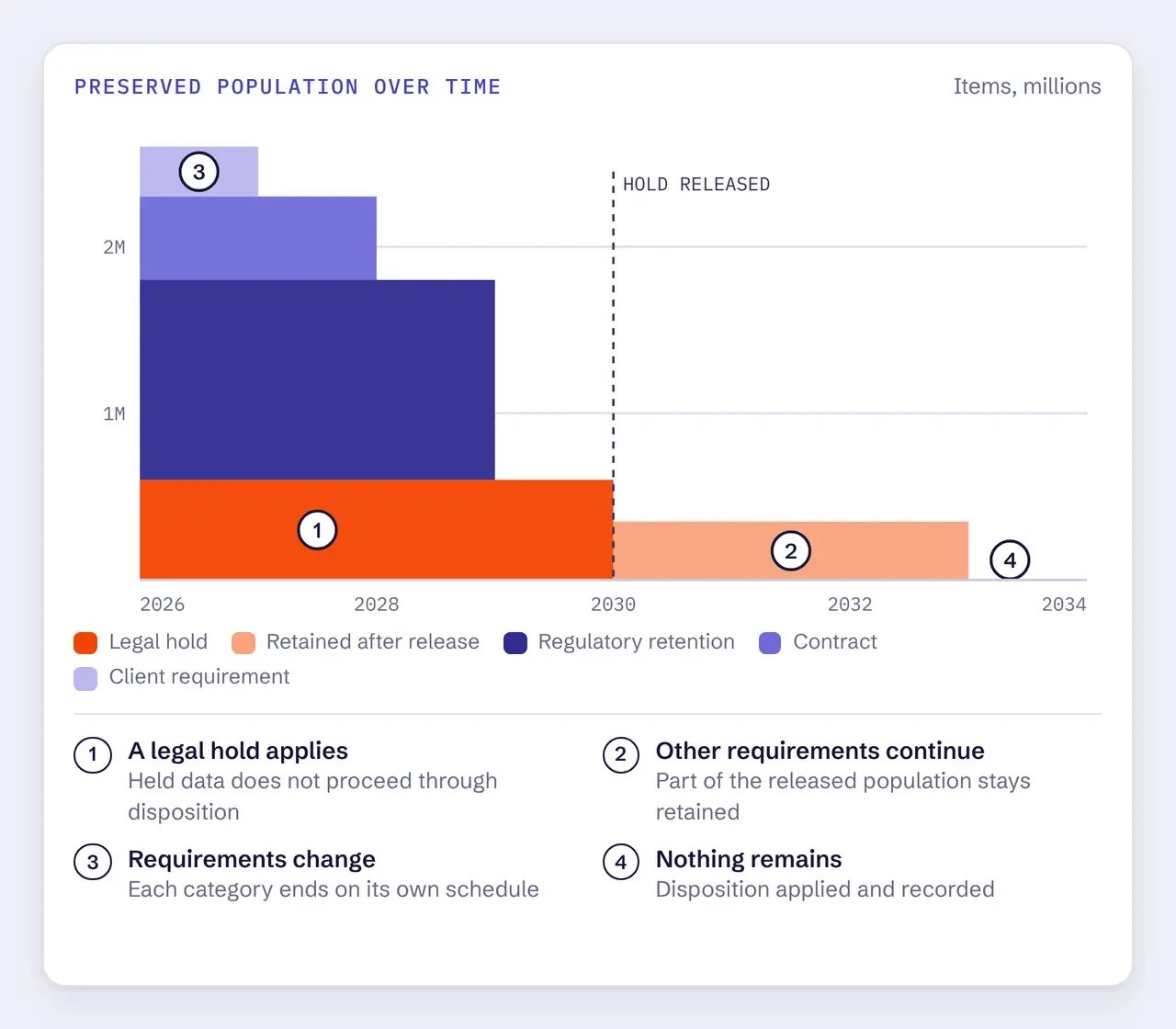
Scheduled expiration is suspended for held data while the hold remains in effect, including where the population's ordinary retention period has already run.
Re-evaluated on release
When a hold is released, the population is re-evaluated against the requirements that still apply rather than becoming immediately eligible for disposition.
Working with a preserved population
Preserved data must remain accessible to serve its purpose. Authorized teams can search, preview, and export selected information without restoring the source environment or moving the entire population downstream.
Search
Metadata and full-text search where available, to locate the relevant subset.
Preview
Inspection of supported content before deciding whether it needs to move or receive deeper review.
Filter and segment
Organization of large populations by metadata, legal status, classification, and other supported attributes.
Classification
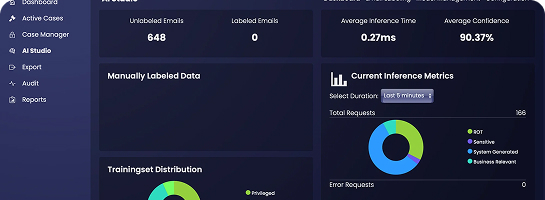
AI Studio models trained on your own examples, applied to preserved email so review can start with business-relevant, potentially privileged, and sensitive messages.
Export
Delivery of a selected subset to a DMS, review platform, production system, counsel, or another approved destination, without exporting the whole population.
Access and audit
Role-based access to defined populations, with access, export, retention, and disposition activity recorded where supported.
Preservation without the next dependency
A preservation platform is a poor answer to Legal Data Lock-In™ if leaving it is as difficult as leaving the archive it replaced. Portability belongs in the architecture rather than in the contract.
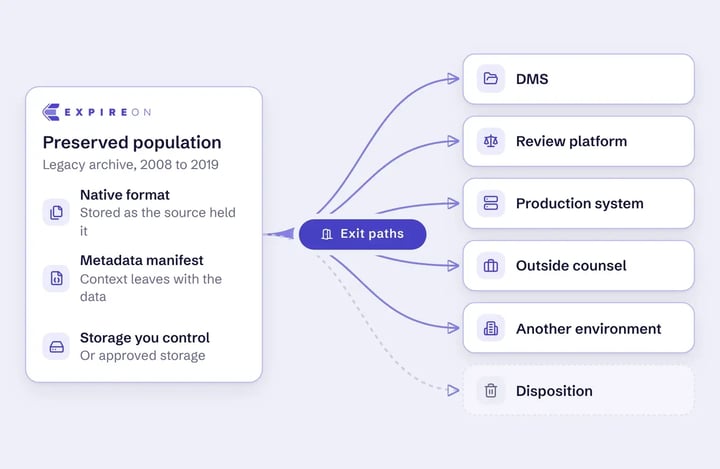
Preserved data exports in native format with a metadata manifest, so what made the population understandable inside Expireon travels with it
Export delivers a selected subset to a DMS, review platform, production system, counsel, or another approved destination as a supported workflow rather than a special request.
Moving data out of Expireon storage carries no egress charge.
The file a message pointed to keeps changing after it is sent. Where supported, Expireon resolves the linked file and retains the version associated with the sharing event, so a reviewer sees what the message referenced at the point it was sent.
WHAT IS PRESERVEDThe communication
The message that gives the file its factual and legal context.
WHAT IS PRESERVEDThe linked file
Expireon resolves the reference, so preservation does not stop at a hyperlink.
WHAT IS PRESERVEDThe version at the time of sharing
The state of the file associated with the communication, rather than whatever it became afterward.
WHAT IS PRESERVEDThe relationship
The association between the two, so they remain connected in later search, review, and export.
When the file is gone
Where the exact version is unavailable or the file no longer exists, the gap is recorded rather than passed over.
Preservation has an end
Preservation that never concludes is accumulation. Expireon connects legal hold, retention, expiration, and disposition so a population reaches a governed outcome rather than remaining by default.
A legal hold applies | Held data does not proceed through disposition while the hold remains in effect.
Other requirements continue | Regulatory, client, contractual, records, and governance requirements continue to apply after a hold is released.
Requirements change | A population can remain preserved, move to another destination, or become eligible for disposition as its requirements evolve.
Nothing remains | Approved expiration or disposition applies, and what was disposed of is recorded.
Where Expireon ends and CaseFusion begins
Cloudficient's two platforms answer different questions.
The Context-Aware eDiscovery platformCaseFusion®
Supports matter-centered identification, legal hold, preservation and collection workflows, and early case assessment.
Legal data preservation keeps information subject to continuing legal, regulatory, client, contractual, or governance requirements protected, searchable, and under any applicable legal hold, independently of the system it came from, for as long as the requirement lasts.
Can a legal hold survive the system being retired?
Yes, provided the data is preserved in an environment that maintains the hold independently. The hold is an obligation attached to the information, not to the system that stored it.
What happens to preserved data when a legal hold is released?
It is re-evaluated against the requirements that still apply. Regulatory, client, contractual, and records requirements can continue after a hold ends, so release does not by itself make a population eligible for disposition.
How are hyperlinked files preserved with an email?
Where supported, the linked file is resolved, the version associated with the sharing event is retained, and the association between the communication and the file is preserved, so a reviewer later sees what the message referenced when it was sent.
How long should legally significant data be preserved?
For as long as the underlying obligation lasts, which is set by the matter, the regulation, the contract, or the records schedule rather than by the platform. Preserved information should carry a defined path to disposition when the requirement ends.
Keep preserved data usable for as long as you have to keep it
Preservation decisions are easier to make before the change than during it. We will walk through what gets preserved alongside your data, how a legal hold would survive the changes you already know are coming, and what it takes to move or end a population when its requirement does.