People accumulate accounts, aliases, and directory records as names, roles, employment status, and organizations change.

Know who was there, and which sources they used
CaseFusion® establishes who held a relevant role when the events occurred, resolves accounts and aliases that belong to the same person, and shows which repositories a custodian used, so scope is built with better information, not more data.
Everything downstream inherits the decisions made here.
Who receives a hold, which repositories are preserved, what is collected, and how much ESI reaches processing and review are all settled during identification. Every stage after it inherits those answers, and by the time a gap surfaces, the matter has already been built on top of it.
CaseFusion is the first eDiscovery platform built to establish those answers rather than receive them as an input.
Five capabilities do that work:
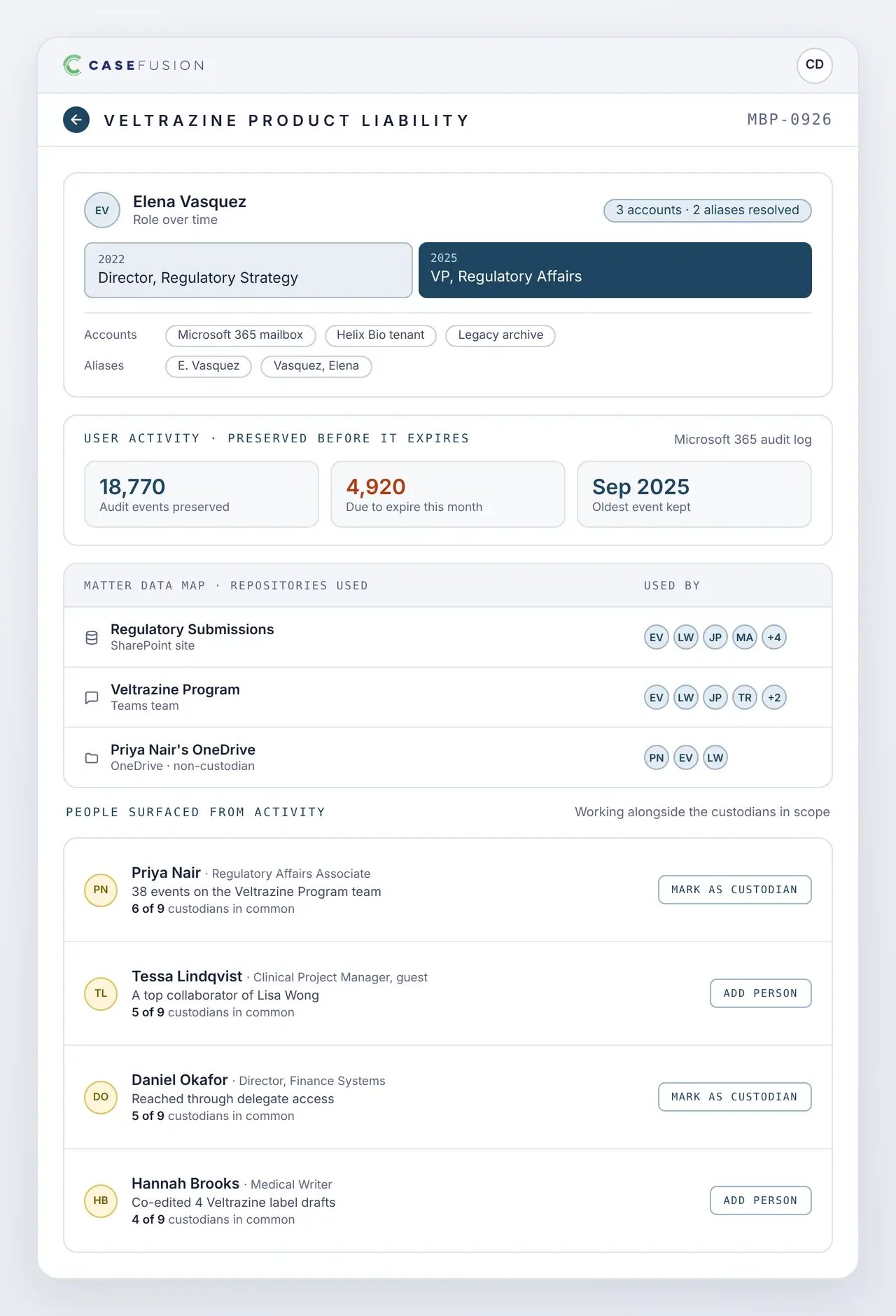
- Effective-dated identity, showing who held a role during the period the matter concerns
- Identity resolution, associating the accounts, aliases, and addresses that belong to one person
- User activity, preserved before it expires
- A matter data map built from that activity, showing which repositories were used and by whom
- People surfaced from activity who are working alongside the custodians already in scope
See who held each role at the relevant time
Effective-dated identity shows roles, reporting lines, team membership, and responsibility during the relevant period, rather than only what appears in the current directory.
Titles, departments, and account details may have changed since the events at issue.
A person outside the current team may have held the relevant role or responsibility during the period at issue.
A current manager may have arrived later or belonged to a different reporting structure when the events occurred.
A process may move between departments, along with the people who understand how it worked during the relevant period.
CaseFusion® brings together effective-dated identity from Microsoft Entra ID, HRIS platforms, and other supported sources.
Use the organization as it existed during the relevant period to identify custodians, subject-matter experts, managers, and organizational relationships.
See one person across multiple accounts
Identity resolution connects accounts, aliases, and directory records to the person they represent, helping teams identify a custodian’s ESI across organizational change.
When related records remain separate, accounts and repositories associated with a custodian may be overlooked.
CaseFusion uses available identity attributes to associate supported records with the same person.
Teams can review the identity information supporting an association rather than relying on an unexplained match.
Connected identities help teams identify the accounts, repositories, and ESI that may belong in the matter.
When the available information does not support a reliable match, teams can review the records before deciding whether they belong to the same person.
Identification in a Microsoft 365 environment
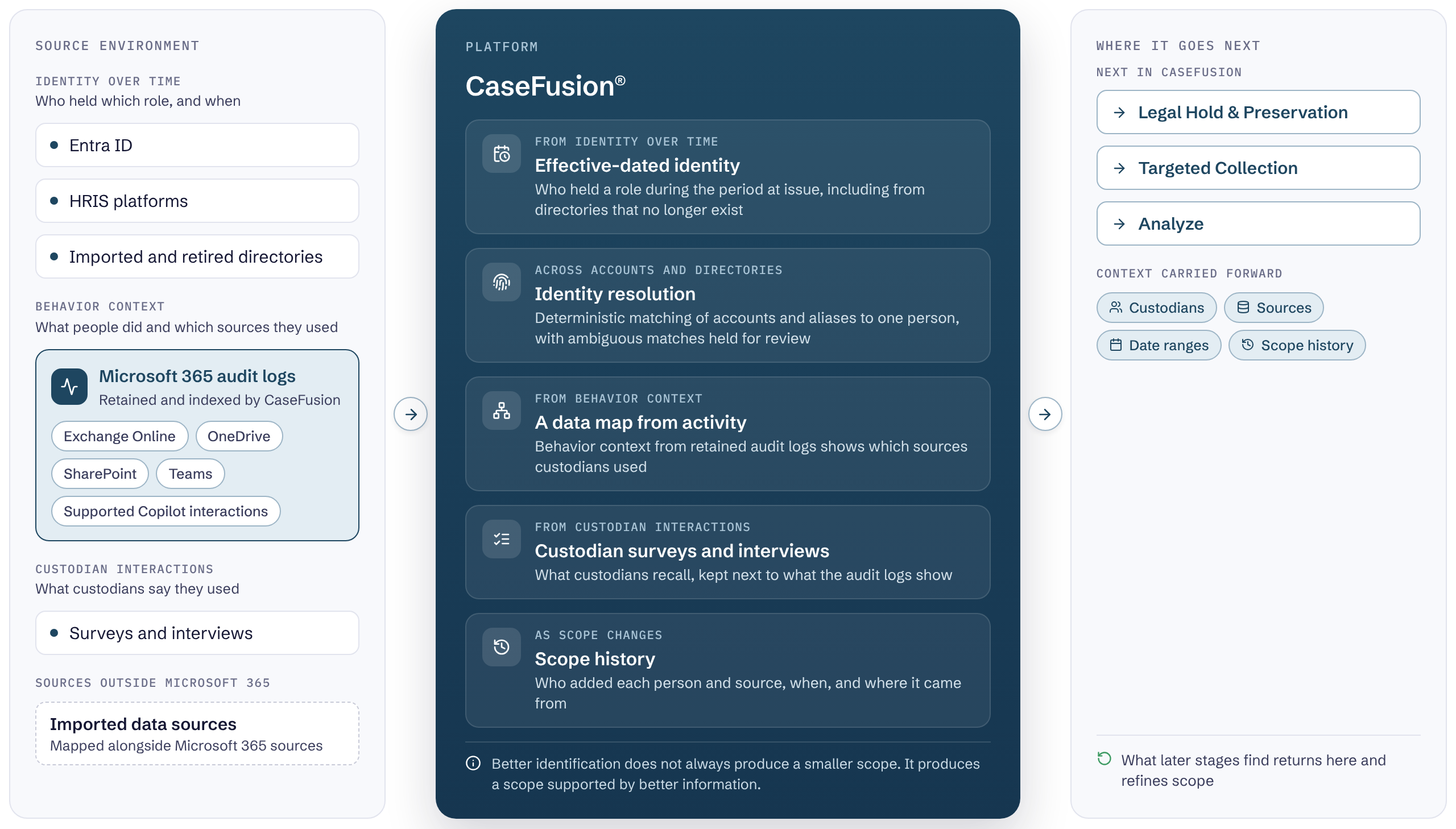
Microsoft provides important native identity, preservation, search, audit, and collection capabilities. CaseFusion adds effective-dated identity from directories that may no longer exist, activity retained past the standard window, and the record of how a scope decision was reached.
Identification in a Microsoft 365 environment
Microsoft provides important native identity, preservation, search, audit, and collection capabilities. CaseFusion adds effective-dated identity from directories that may no longer exist, activity retained past the standard window, and the record of how a scope decision was reached.

See which repositories a custodian used
Available activity records can show which repositories a custodian interacted with during the relevant period, complementing interviews, organizational information, and permissions.
Custodian interviews capture remembered systems and working practices. Activity records can identify additional repositories for investigation.
Org charts show reporting structures, and permissions show potential access. Neither establishes observed activity.
Available Microsoft 365 audit activity can associate a user with recorded file, repository, or administrative events and their timing.
Availability depends on licensing, record type, and retention policy. Records needed for later matters must be retained before they expire.
CaseFusion® retains and indexes available Microsoft 365 audit records so the activity remains available when a matter arises.
Use retained activity with identity and matter information to map people, repositories, relationships, and data sources that may bear on the matter.
Build scope around the matter
Bring known custodians, historical identity, activity, and interview responses together. Then record each scope decision as the matter develops.
Begin with the known custodians, issues, and relevant date range.
Use historical identity and retained activity to identify associated repositories and sources and build a matter-relevant data map.
Add custodian survey and interview responses to the matter alongside available activity information.
Compare interview responses with available activity to identify gaps, additional people, and sources outside the initial scope.
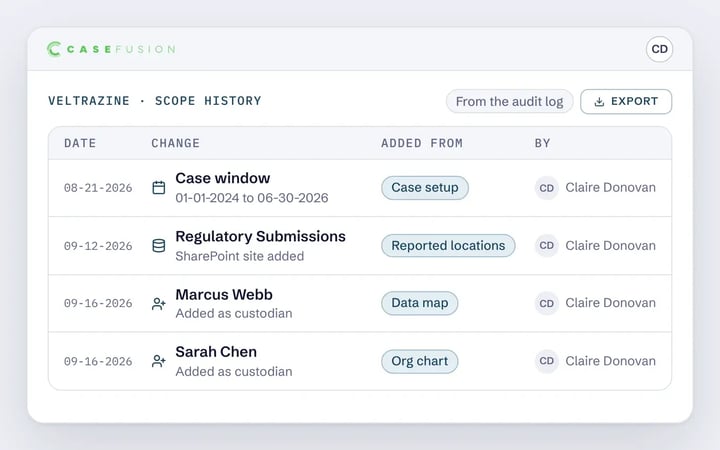
Record which custodians, repositories, and date ranges are in or out of scope, together with the basis for each decision.
Repeat the process as new custodians or sources emerge, and record how and why the scope changed.
Identification produces a scope that every later stage inherits. What typically gets left behind are the decisions made and what those decisions were based on.
-
CaseFusion keeps those decisions with the matter
-
The custodians, repositories, and date ranges in scope are recorded together with the information they were based on.
CaseFusion Identify FAQs
Give every matter a better starting point
See how CaseFusion establishes who belonged to the matter when it happened, which sources they used, and why each one is in scope.