Scope
Takes the preserved population and the matter data map, and establishes which sources and which people's activity the collection covers.





CaseFusion® collects against recorded activity rather than against repository membership, so what moves downstream is the work that bears on the matter. Messages arrive with the conversations that explain them and the files they pointed to, and everything preserved stays preserved.
Preservation is comparatively inexpensive and it is reversible. Processing, hosting, and review are neither. What crosses from one to the other is the collection scope.
A departmental SharePoint site or a Teams channel holds years of work from dozens of people, in many versions, and a custodian's membership in it says nothing about which of that work bears on the matter.
Three ways to set collection scope
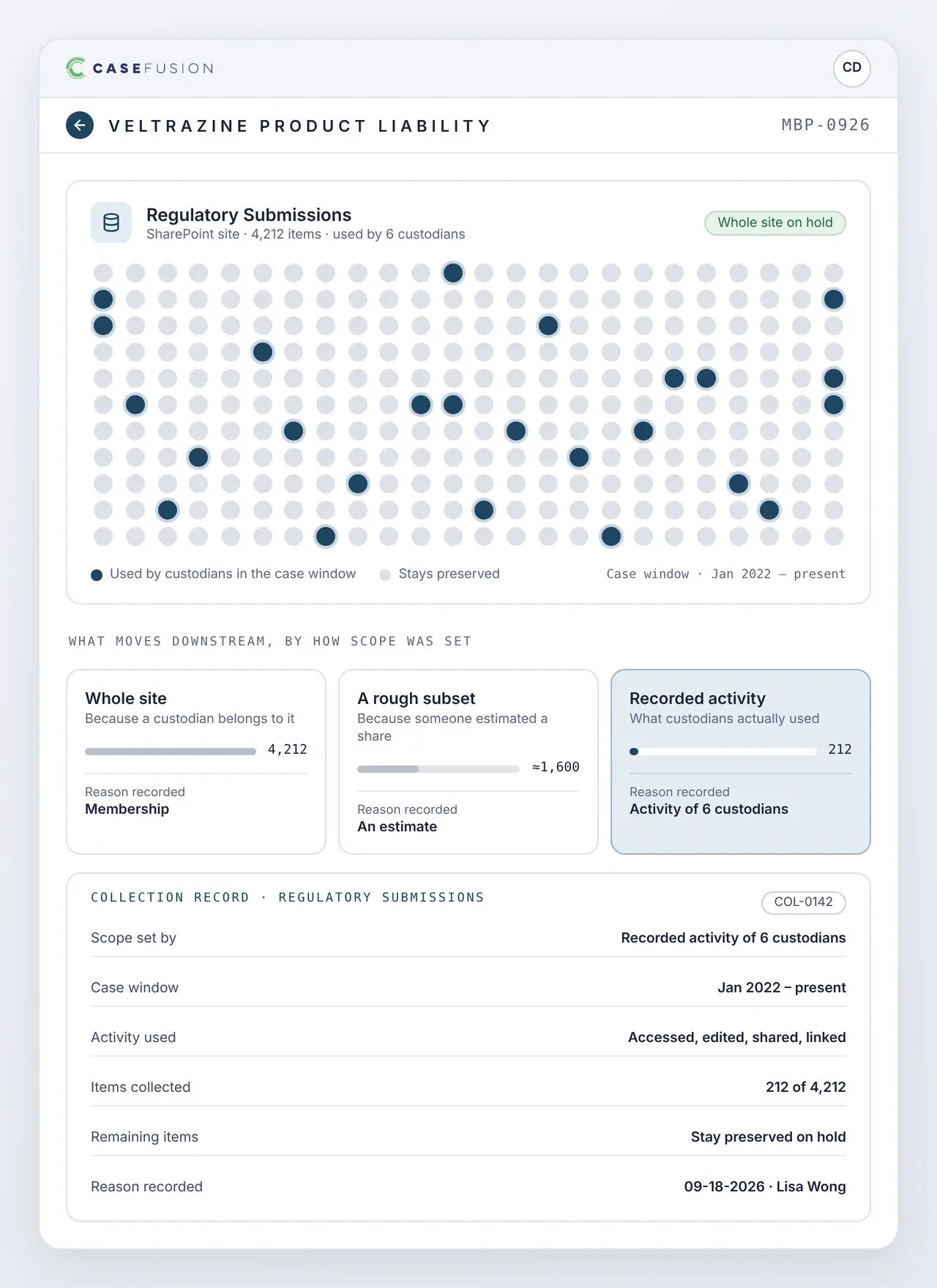
Where a shared site has two hundred members and a dozen of them did anything bearing on the matter, that is a collection of a dozen people's work rather than two hundred.
Targeting is a choice rather than a constraint. Where a matter calls for a full source, or where no activity record covers the period at issue, CaseFusion collects the source as preserved.
Recorded activity also supports the decision not to collect. A preserved source with no recorded interaction from anyone in scope can be left out of collection, and the basis for leaving it out is recorded alongside the decision.
Activity decides what is collected. It never decides what is preserved. A custodian's own accounts and the shared sources they belong to stay under hold whether or not anyone has touched the content recently.
A document drafted years before the matter and never opened since is still in the organization's possession, custody, and control.
A source left out of collection stays under hold. Nothing is released, nothing is lost, and the exclusion is reversible the moment new information warrants it.
CaseFusion collects mailbox, OneDrive, Teams, and SharePoint content with its relationships attached. Conversation structure is maintained.
Hyperlinks in collected messages are resolved, and the linked file is captured as it existed when the message was sent. Where a version is unavailable or a file no longer exists, that is recorded with the message it belongs to.
A laptop in an endpoint inventory, a line-of-business application, a paper file, a system owned by another team. The request workflow routes the collection task to the person who owns that system and tracks it to completion inside the matter.
Sources can be created directly in CaseFusion or imported from another system of record. The result is one collection status for the matter rather than a platform view and a spreadsheet that has to be reconciled against it.
Your reviewers open a message with everything that explains it already attached.
Takes the preserved population and the matter data map, and establishes which sources and which people's activity the collection covers.
Selects content by recorded interaction during the relevant period rather than by repository membership, or collects a source in full where the matter calls for it.
Collects mailbox, OneDrive, Teams, and SharePoint content, maintaining conversation structure and the relationships among messages, attachments, files, and participants.
Follows hyperlinks in collected messages to the files they reference and captures the versions associated with the events that referenced them.
Records what was collected, what was left out, what could not be captured, and the basis for each.
Sends what collection reveals to identification and the hold, where new people and sources re-enter scope.
Microsoft provides important native preservation, search, audit, and collection capabilities. CaseFusion adds retained activity, the matter data map, resolved links and the versions attached to specific events, and the record of the decisions made along the way.
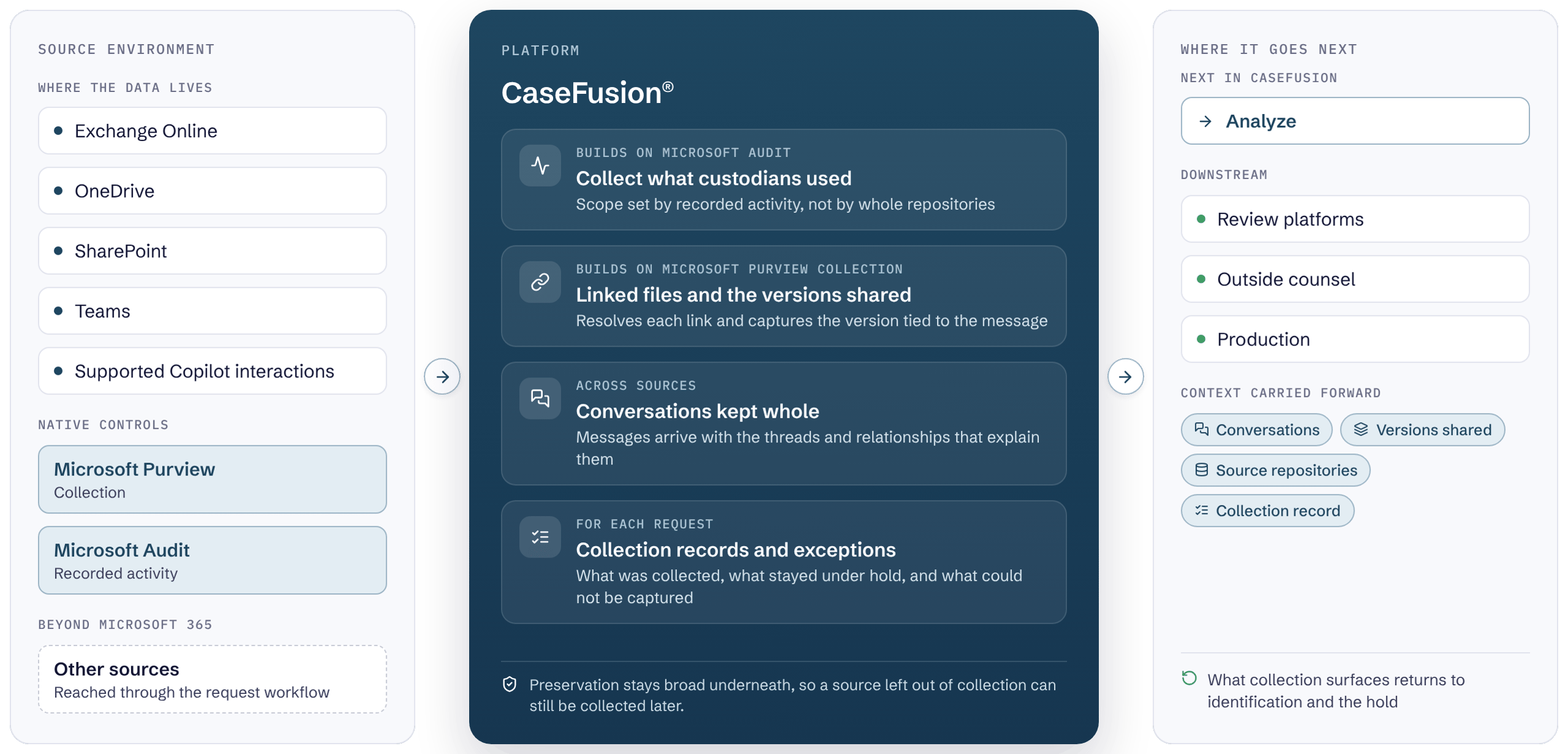
Microsoft provides important native preservation, search, audit, and collection capabilities. CaseFusion adds retained activity, the matter data map, resolved links and the versions attached to specific events, and the record of the decisions made along the way.
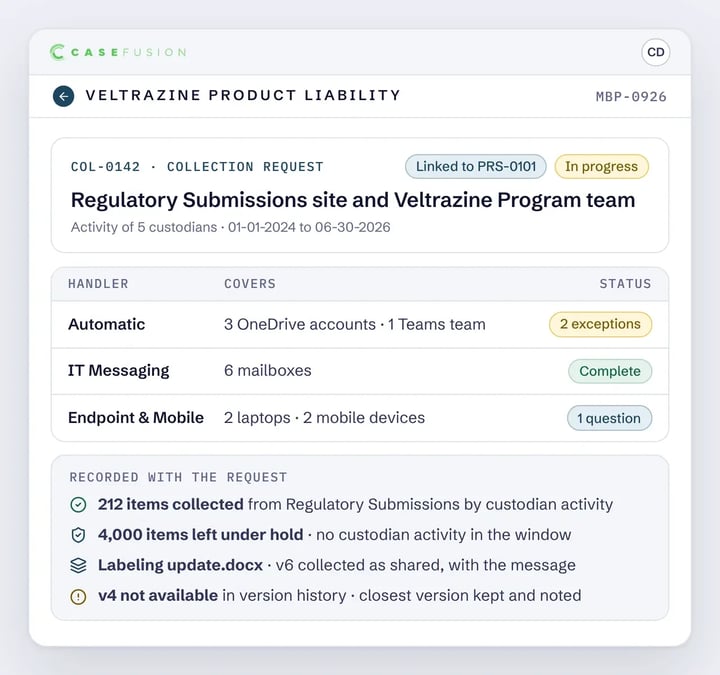
A collection scope is a set of decisions: this source and not that one, these people's activity and not everyone's, this version and not the current one. Each is reasonable when made and difficult to reconstruct afterward.
Which sources were collected and which were left under hold, and whose activity drove the selection.
Which versions were captured, and which items could not be captured and why.

See how CaseFusion uses recorded activity to decide what a matter needs to collect, and keeps everything else preserved.