Reconstruct historical identity
Effective-dated identity shows that one custodian held a different role during the relevant period and identifies the manager responsible for that function at the time.




CaseFusion® processes the collected population and analyzes it with context, so a legal team can understand the matter and reduce what goes to review. What remains moves downstream with that context attached.
Cloud collaboration creates a record around every document: which version, who opened it and when, and what role they held at the time. Most of it never reaches review. That is the context gap, and CaseFusion closes it by carrying the record into analysis alongside the content.
What changes when context reaches analysis
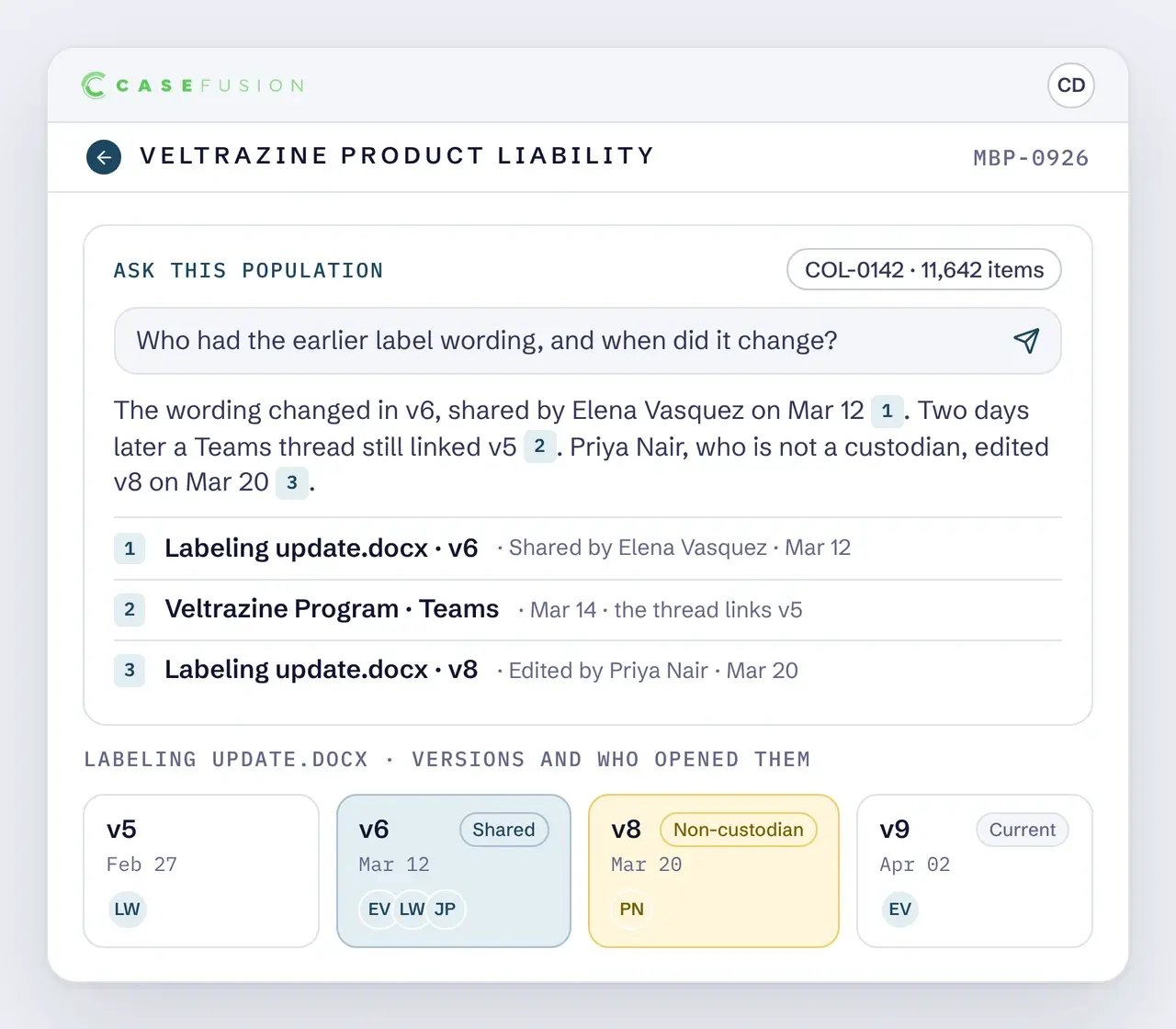
In the standard sequence, a legal team learns what a matter involves after the population has gone to a downstream provider, been processed, and been loaded for review.
Decisions become reversals | Processing has been paid for and hosting has started, so acting on what the analysis shows means unwinding decisions rather than making them.
Context arrives stripped away | A reviewer has to work out which repository a document came from, who held which role when it was created, which version the recipient opened, and why the item is in the matter at all.
Analyze runs against a defined matter population. Each result remains traceable to that population, the question or search used, and the ESI that produced it.
Prepare collected ESI for analysis by extracting and normalizing text, metadata, and timestamps. Preserve families, threads, and version relationships during deduplication, then connect each item to available audit and access activity.
See the population before examining individual items: volume, sources, file types, languages, timelines, and apparent gaps.
Review custodian identities and aliases, roles and reporting lines over time, and communication patterns during the relevant period.
Search the indexed population using keyword, semantic, and concept methods. Build and compare queries, then save the searches that become part of the matter record.
Ask the population a question and receive an answer grounded in cited passages from the ESI. Use the answer as a traceable starting point for investigation, not as a coding decision.
Test the proposed scope through sampling and search-term reports across included and excluded populations. Reduce what moves downstream where the information supports it, and record the basis for each decision.
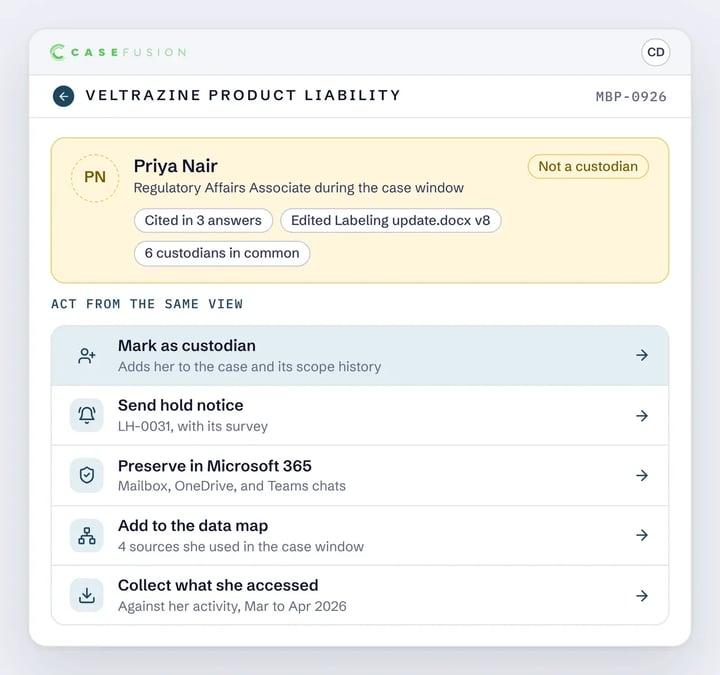
Analysis may identify new people and sources, and CaseFusion makes acting on that information simple and efficient.
Effective-dated identity shows that one custodian held a different role during the relevant period and identifies the manager responsible for that function at the time.
Hold notices are sent to the custodians in scope, with surveys asking what systems they used and who else was involved.
Preservation is applied across each custodian’s mailbox, OneDrive, one-to-one chats, and the Teams and SharePoint sources they belong to.
Indexed activity reveals sustained interaction with a departmental SharePoint site. The site is added to scope, while routine use of the company intranet is documented and excluded.
Culling rules are named, ordered, and repeatable.
Populations proposed for exclusion are sampled before anything is excluded.
Each exclusion is recorded against the rule that produced it, the reason, the sample drawn, and the person who approved it.
Before anything is promoted, the reviewable population is locked, so what went downstream and what stayed behind are both fixed and both accounted for.
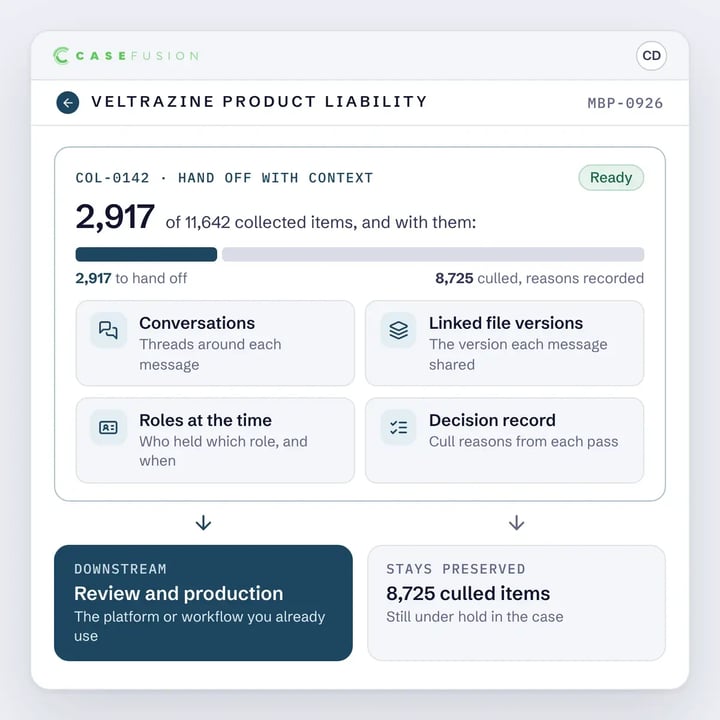
Analyze covers the work between collection and review: processing the population, understanding it, validating it, and deciding what moves on.
Review and production run downstream, in RelativityOne or another review workflow.
CaseFusion promotes the culled population with the context it was built from and the record of the decisions that produced it.
The receiving team does not repeat the work.
What is analyze in CaseFusion?
Does analyze include document review?
What does analyze do that a review platform does not?
Does AI in analyze decide what is relevant?
How is a pre-review reduction defended?
Can what analyze finds change the scope of a matter?

See how CaseFusion analyzes a collected population with the identity, repository, and relationship information the collection was built from, and returns what it finds to the rest of the matter.